Canadian Mortgage Amortization Explained: Semi-Annual Compounding Mechanics and the Accelerated Bi-Weekly Advantage
Unlike residential mortgages in the United States or Western Europe—which typically apply simple monthly compounding over a single 15- or 30-year fixed term—the Canadian mortgage system operates under a unique statutory and actuarial framework. Governed by Section 6 of the federal Interest Act (R.S.C., 1985, c. I-15), every fixed-rate residential mortgage secured by real property in Canada must quote its nominal interest rate as compounded semi-annually, not in advance (composé semestriellement, et non à l'avance).
For a Canadian homebuyer borrowing $500,000 to $800,000, this statutory compounding rule—combined with 5-year term renewals, tiered CMHC (Canada Mortgage and Housing Corporation) default insurance premiums, the federal 30-year insured amortization reform, and payment frequency mechanics—creates lifetime interest cost differences exceeding $75,000 to $125,000. Yet a majority of retail borrowers still confuse Regular Bi-Weekly and Accelerated Bi-Weekly payment schedules, or rely on U.S. online mortgage calculators that systematically miscalculate Canadian payments.
In this institutional guide, we derive the exact actuarial formulas governing Canadian mortgages, quantify the true cost of CMHC insurance (including non-financeable provincial sales tax in Ontario, Quebec, and Saskatchewan), and prove why switching to an Accelerated Bi-Weekly schedule eliminates over 3.3 years of debt. You can model your exact amortization schedule dollar-for-dollar in our Canadian Mortgage Amortization Calculator.
1. The Statutory Mathematics of Canadian Semi-Annual Compounding
In the United States, if a lender advertises a nominal annual fixed mortgage rate $r_{\text{nom}} = 5.00%$, the monthly periodic interest rate charged to the borrower is simply one-twelfth of the stated rate:
$$i_{\text{US}} = \frac{0.05}{12} = 0.41667% \text{ per month}$$
Compounding that rate 12 times per year yields an Effective Annual Rate ($\text{EAR}$) of:
$$\text{EAR}_{\text{US}} = \left(1 + \frac{0.05}{12}\right)^{12} - 1 = 5.1162%$$
In Canada, Section 6 of the Interest Act prohibits monthly compounding of the quoted nominal rate on fixed-rate mortgages so borrowers can transparently compare loan offers. Whether you borrow from RBC, TD, BMO, Scotiabank, CIBC, National Bank, or Desjardins, a stated fixed rate $r_{\text{nom}}$ can only be compounded twice per year (every 6 months).
Step 1: The Canadian Effective Annual Rate ($\text{EAR}$)
Given a quoted nominal annual rate $r_{\text{nom}}$, the semi-annual rate is $r_{\text{nom}} / 2$. Compounded over two 6-month periods per year, the true Effective Annual Rate ($\text{EAR}$) of a Canadian fixed-rate mortgage is:
$$\text{EAR} = \left(1 + \frac{r_{\text{nom}}}{2}\right)^2 - 1$$
At $r_{\text{nom}} = 5.00%$, the semi-annual rate is $2.50%$, which produces:
$$\text{EAR} = (1 + 0.025)^2 - 1 = 1.050625 - 1 = 5.0625%$$
Notice immediately that at the exact same advertised rate of $5.00%$, a Canadian fixed-rate mortgage carries an effective annual interest rate ($5.0625%$) that is 5.37 basis points lower than an American mortgage ($5.1162%$).
Step 2: The Equivalent Periodic Rate ($i_m$)
Because borrowers make payments at a frequency of $m$ times per year ($m = 12$ for monthly, $m = 24$ for semi-monthly, $m = 26$ for bi-weekly, or $m = 52$ for weekly), the lender must compute the equivalent periodic interest rate $i_m$ that, when compounded $m$ times per year, equals the semi-annual $\text{EAR}$:
$$(1 + i_m)^m = \left(1 + \frac{r_{\text{nom}}}{2}\right)^2$$
Solving for $i_m$ yields the master equation used by every Canadian bank's underwriting system and by our Canadian Mortgage Calculator:
$$i_m = \left(1 + \frac{r_{\text{nom}}}{2}\right)^{\frac{2}{m}} - 1$$
For a standard monthly payment schedule ($m = 12$) at $r_{\text{nom}} = 5.00%$:
$$i_{12} = (1.025)^{\frac{2}{12}} - 1 = (1.025)^{\frac{1}{6}} - 1 \approx 0.004123915 \quad (0.41239% \text{ per month})$$
Step 3: Base Monthly Amortization Payment ($P_{\text{monthly}}$)
With the exact equivalent monthly rate $i_{12}$, the constant monthly payment $P_{\text{monthly}}$ required to amortize a total loan principal $L$ over $N = 12 \times A$ months (where $A$ is the amortization period in years, typically 25 or 30 years) follows the standard level-annuity equation:
$$P_{\text{monthly}} = L \cdot \frac{i_{12} (1 + i_{12})^N}{(1 + i_{12})^N - 1}$$
On a $500,000 net mortgage amortized over 25 years ($N = 300\text{ months}$) at $5.00%$:
- Exact Canadian Formula ($i_{12} = 0.4123915%$): $2,908.02 / month (total 25-year interest: $372,407).
- Incorrect U.S. Monthly Formula ($i = 0.4166667%$): $2,922.95 / month (an error of +$14.93 / month or +$4,479 over the life of the mortgage).
2. Minimum Down Payment Tiers and CMHC Mortgage Default Insurance
Before entering the amortization formula, the total mortgage principal $L$ must account for federal down payment rules and mandatory high-ratio mortgage default insurance (provided by CMHC, Sagen, or Canada Guaranty) whenever the down payment is under $20%$ of the purchase price ($\text{Loan-to-Value} > 80%$).
Federal Minimum Down Payment Structure in Canada
Canadian federal banking regulations divide the minimum down payment $D_{\min}$ into three tiers based on the property's purchase price $V_0$:
- First $500,000 of Purchase Price: Minimum down payment of $5%$.
- Portion Between $500,000 and the Insured Mortgage Cap ($1,500,000): $5%$ on the first $500,000 ($25,000) plus $10%$ on the portion above $500,000.
- Properties of $1,500,000 or More (Uninsurable): Strict minimum down payment of $20%$ across the entire purchase price.
For example, on an $800,000 residential property, the minimum statutory down payment is:
$$D_{\min} = ($500,000 \times 5%) + (($800,000 - $500,000) \times 10%) = $25,000 + $30,000 = $55,000 \quad (6.875% \text{ of } V_0)$$
Tiered CMHC Insurance Premiums and the 30-Year Amortization Surcharge
When $D / V_0 < 20%$, the default insurance premium $\tau_{\text{CMHC}}$ is calculated as a percentage of the base loan $L_0 = V_0 - D$ and capitalized directly into the total mortgage principal:
$$L_{\text{total}} = L_0 \cdot (1 + \tau_{\text{CMHC}})$$
Under the federal mortgage reforms allowing first-time homebuyers and buyers of newly constructed homes to choose a 30-year insured amortization (up from the standard 25-year maximum on high-ratio mortgages), an additional $0.20%$ (20 bps) surcharge applies whenever the insured amortization exceeds 25 years:
| Loan-to-Value Ratio ($\text{LTV}$) | Down Payment Tier ($D / V_0$) | Standard CMHC Rate ($\le 25\text{ Yrs}$) | 30-Year CMHC Rate (1st-Time / New Build) | Premium on $L_0 = $500,000$ (25 Yrs) |
|---|---|---|---|---|
| Up to $65%$ | $\ge 35%$ | $0.60%$ | $0.80%$ | $3,000 |
| $65.01%$ to $75%$ | $25%$ to $34.99%$ | $1.70%$ | $1.90%$ | $8,500 |
| $75.01%$ to $80%$ | $20%$ to $24.99%$ | $2.40%$ | $2.60%$ | $12,000 |
| $80.01%$ to $85%$ | $15%$ to $19.99%$ | $2.80%$ | $3.00%$ | $14,000 |
| $85.01%$ to $90%$ | $10%$ to $14.99%$ | $3.10%$ | $3.30%$ | $15,500 |
| $90.01%$ to $95%$ | $5%$ to $9.99%$ | $4.00%$ | $4.20%$ | $20,000 |
The Hidden Cash-at-Closing Trap: Provincial Sales Tax on CMHC Premiums
While the CMHC premium itself ($20,000 on a $500,000 loan with $5%$ down) is rolled into the mortgage principal $L_{\text{total}}$, three Canadian provinces levy a provincial sales tax on insurance premiums that cannot be financed into the mortgage and must be paid in cash at the lawyer's or notary's office on closing day:
- Quebec: $9.00%$ tax on insurance premiums ($1,800 cash on a $20,000 CMHC premium).
- Ontario: $8.00%$ Retail Sales Tax—RST ($1,600 cash on a $20,000 premium).
- Saskatchewan: $6.00%$ Provincial Sales Tax ($1,200 cash).
Furthermore, because the $20,000 CMHC premium is financed inside the mortgage at $5.00%$ over 25 years, it accrues $14,896 in additional mortgage interest, bringing the true lifetime economic cost of a 5%-down CMHC policy in Quebec or Ontario to $36,496–$36,696.
3. Regular Bi-Weekly vs. Accelerated Bi-Weekly: The Mathematical Proof
Payment frequency is the single most misunderstood lever in Canadian retail banking. Lenders offer four primary schedules:
- Monthly ($12\text{ payments / year}$)
- Semi-Monthly ($24\text{ payments / year}$, e.g., on the 1st and 15th of each month)
- Regular Bi-Weekly ($26\text{ payments / year}$, every second Thursday or Friday)
- Accelerated Bi-Weekly ($26\text{ payments / year}$)
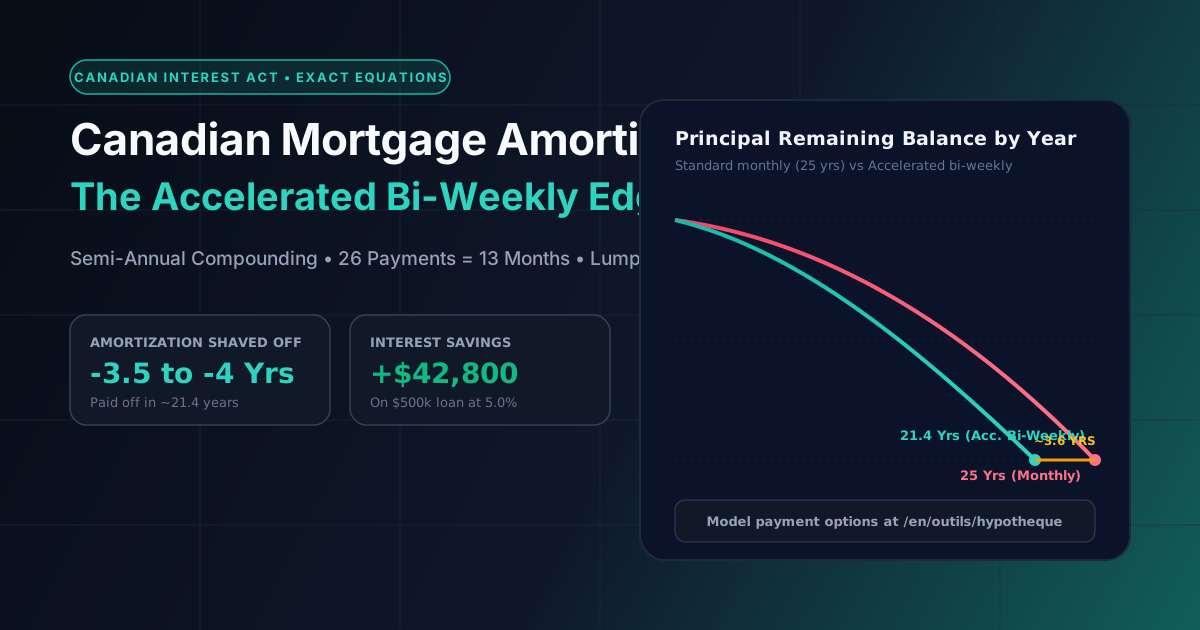
Why do homeowners who select Regular Bi-Weekly save almost nothing, whereas those who select Accelerated Bi-Weekly shave more than three years off their mortgage? Because the two formulas are constructed differently.
1. Regular Bi-Weekly Formula (Non-Accelerated)
A Regular Bi-Weekly schedule takes your monthly payment, multiplies it by 12 months, and divides by 26 pay periods:
$$P_{\text{regular bi-weekly}} = \frac{P_{\text{monthly}} \times 12}{26}$$
Over a 26-period calendar year, your total annual cash outflow is:
$$\text{Annual Outflow}{\text{regular}} = 26 \times \left(\frac{P{\text{monthly}} \times 12}{26}\right) = 12 \times P_{\text{monthly}}$$
In other words, Regular Bi-Weekly pays the exact same annual dollar amount as a Monthly mortgage. Its only advantage is slightly earlier principal timing within each month, which trims a 25-year amortization by barely 3 to 4 months.
2. Accelerated Bi-Weekly Formula
An Accelerated Bi-Weekly schedule sets each two-week payment equal to exactly half of the monthly payment:
$$P_{\text{accelerated bi-weekly}} = \frac{P_{\text{monthly}}}{2}$$
Because a calendar year has 52.14 weeks—meaning 26 bi-weekly periods—your total annual cash outflow becomes:
$$\text{Annual Outflow}{\text{accelerated}} = 26 \times \left(\frac{P{\text{monthly}}}{2}\right) = 13 \times P_{\text{monthly}}$$
Here lies the mathematical engine of the accelerated schedule: by paying half a monthly payment every two weeks, you automatically inject one full 13th monthly payment into your mortgage every single year, and $100%$ of that 13th payment goes directly toward reducing principal.
Calculating the Compressed Amortization ($N_{\text{accelerated}}$)
Using the bi-weekly equivalent periodic rate $i_{26} = (1 + r_{\text{nom}}/2)^{2/26} - 1$, the exact number of bi-weekly payments $N_{26}$ required to extinguish a loan $L$ with payment $P_{\text{acc}} = P_{\text{monthly}} / 2$ is given by the logarithmic annuity inversion formula:
$$N_{26} = -\frac{\ln\left(1 - \frac{L \cdot i_{26}}{P_{\text{acc}}}\right)}{\ln(1 + i_{26})}$$
Dividing $N_{26}$ by 26 periods per year shows that Accelerated Bi-Weekly compresses a 25-year mortgage to 21.7 years (saving 3.3 years of debt service), and compresses a 30-year mortgage by more than 4.4 years.
4. Quantitative Comparison: $500,000 Canadian Mortgage at 4.89%
Let's compare all five amortization and payment structures on a $500,000 net mortgage at a fixed nominal rate of $4.89%$ compounded semi-annually ($\text{EAR} = 4.9498%$), matching the exact output of our Canadian Mortgage Amortization Calculator:
| Payment Schedule & Amortization | Periodic Payment | Total Paid Per Year | Effective Amortization | Total Lifetime Interest | Net Interest Saved vs. 25-Yr Monthly |
|---|---|---|---|---|---|
| Monthly (30-Year Amortization) | $2,635.09 / mo | $31,621 | $30.0\text{ years}$ ($360\text{ mos}$) | $448,632 | −$85,185 (extra cost) |
| Standard Monthly (25-Year Amort.) | $2,876.24 / mo | $34,515 | $25.0\text{ years}$ ($300\text{ mos}$) | $363,447 | Baseline ($0) |
| Regular Bi-Weekly (25-Year Base) | $1,327.50 / 2 wks | $34,515 | $24.7\text{ years}$ ($642\text{ pmts}$) | $357,910 | +$5,537 |
| Accelerated Bi-Weekly (25-Yr Base) | $1,438.12 / 2 wks | $37,391 | $21.7\text{ years}$ ($564\text{ pmts}$) | $308,025 | +$55,422 |
| Accelerated Weekly (25-Year Base) | $719.06 / wk | $37,391 | $21.6\text{ years}$ ($1,125\text{ pmts}$) | $306,840 | +$56,607 |
Three Institutional Takeaways for Canadian Borrowers
- The True Cost of 30-Year Amortization: Extending your amortization from 25 to 30 years lowers your monthly obligation by $241.15/month ($2,876.24 $\to$ $2,635.09), improving your GDS/TDS qualification ratios. However, staying on that 30-year schedule costs $85,185 in extra after-tax interest (plus the $0.20%$ CMHC surcharge if insured).
- Regular vs. Accelerated Bi-Weekly: Switching from Regular Bi-Weekly ($1,327.50) to Accelerated Bi-Weekly ($1,438.12) costs only $110.62 more every two weeks, yet increases your lifetime interest savings tenfold—from $5,537 to $55,422—while making you mortgage-free 3 years and 4 months earlier.
- The "Contractual 30-Year + Accelerated Prepayment" Playbook: An eligible first-time buyer can lock in a 30-year contractual amortization to keep their mandatory contractual minimum payment low (providing a built-in liquidity buffer during parental leave or job transitions), while immediately electing Accelerated Bi-Weekly payments or annual lump-sum prepayments to achieve an effective 22-year payoff without losing payment flexibility.
5. Underwriting Reality: GDS / TDS Ratios and the OSFI B-20 Stress Test
Even if a household can comfortably afford the monthly payment at the contract rate of $4.89%$, all federally regulated Canadian lenders supervised by the Office of the Superintendent of Financial Institutions (OSFI / BSIF) must underwrite mortgages under Guideline B-20.
The Minimum Qualifying Rate ($r_{\text{qual}}$)
A bank cannot qualify your debt ratios at your contract rate $r_{\text{contract}}$. Instead, it must test your budget against the Stress-Test Qualifying Rate $r_{\text{qual}}$, defined as the greater of the $5.25%$ regulatory floor or your contract rate plus 200 basis points (+2.00%):
$$r_{\text{qual}} = \max\left(5.25%,; r_{\text{contract}} + 2.00%\right)$$
At a contract rate of $4.89%$, your mortgage is stress-tested at $6.89%$, raising the qualifying monthly payment on a $500,000 25-year loan from $2,876.24 to $3,467.08 / month (+$590.84/month).
At that stress-tested payment $P_{\text{stress}}$, your household gross annual income $Y_{\text{gross}}$ must satisfy two strict ceilings:
- Gross Debt Service Ratio ($\text{GDS} \le 39%$ of $Y_{\text{gross}}$): $$\text{GDS} = \frac{P_{\text{stress}} + \text{Property Taxes} + \text{Heating} + 50% \text{ of Condo Fees}}{Y_{\text{gross}}} \le 39%$$
- Total Debt Service Ratio ($\text{TDS} \le 44%$ of $Y_{\text{gross}}$): $$\text{TDS} = \frac{\text{GDS Housing Costs} + \text{Car Loans} + \text{Student Loans} + \text{Credit Card / LOC Minimums}}{Y_{\text{gross}}} \le 44%$$
Model Your Exact Canadian Mortgage Schedule
Before signing a mortgage commitment or renewal offer, test your exact purchase price, down payment tier, CMHC premium, and payment frequency (Monthly vs. Regular Bi-Weekly vs. Accelerated Bi-Weekly) in our interactive calculator:
👉 Open the TrueVerdikt Canadian Mortgage Amortization Calculator
Comparing homeownership against renting and investing your down payment in low-cost ETFs? Explore our Canadian Buy vs. Rent Stress-Test Calculator and optimize your down payment tax shelter with our RRSP vs. FHSA & $60k HBP Simulator.
7 Costly Mistakes with RRSP & FHSA in Canada
Check the items that apply to your strategy to calculate your live Tax Erosion Score and unlock the quantitative optimization protocol.
2 / 7 erosion factors selected
Select the potential friction points in your current setup:
Unlock the Full PDF Guide + Your RRSP / FHSA Action Plan
Enter your email to immediately unlock all 7 quantitative remedies, Net Future Return (RNF) formulas, and download the complete guide.
100% Free · Zero spam · Unsubscribe in 1 click.
Excel & Notion Financial Model: Canadian Real Estate Acquisition & Stress-Test
The turnkey financial model used by analysts: Buy vs. Rent simulator (5% rule), semi-annual compounding mortgage calculator, Year-5 interest renewal shock (+200 bps), and FHSA/HBP down-payment tracker.
Instant digital delivery • Lifetime access & 2026 updates included • Universal formats
From theory to practice
Understand markets and build an allocation: sector versus index ETFs, rebalancing, currency risk and reading market cycles.
Build an ETF planAuthored & Audited by the TrueVerdikt Quantitative Research Team
Financial engineering, Canadian mortgage actuarial modeling & statistical backtest auditing
Every study published on TrueVerdikt is engineered and verified using deterministic mathematical equations, peer-reviewed academic literature, and primary statutory regulations. No financial institution can alter our algorithms or rankings.
Primary Academic & Regulatory References
- • Bailey, D. H., & López de Prado, M. (2014). The Deflated Sharpe Ratio: Correcting for Selection Bias, Backtest Overfitting, and Non-Normality. The Journal of Portfolio Management, 40(5), 94–107.
- • López de Prado, M. (2018). Advances in Financial Machine Learning (Combinatorial Purged Cross-Validation — CPCV). Wiley.
- • Interest Act of Canada (R.S.C., 1985, c. I-15, s. 6) — Semi-Annual Mortgage Compounding & OSFI Guideline B-20 Residential Underwriting.
- • Canadian Securities Administrators (CSA) — National Instrument 81-101 (Fund Facts, MER/TER) & Canada Revenue Agency (CRA — FHSA, RRSP, HBP).
Keep reading
All articles in this section « Macro & rates » →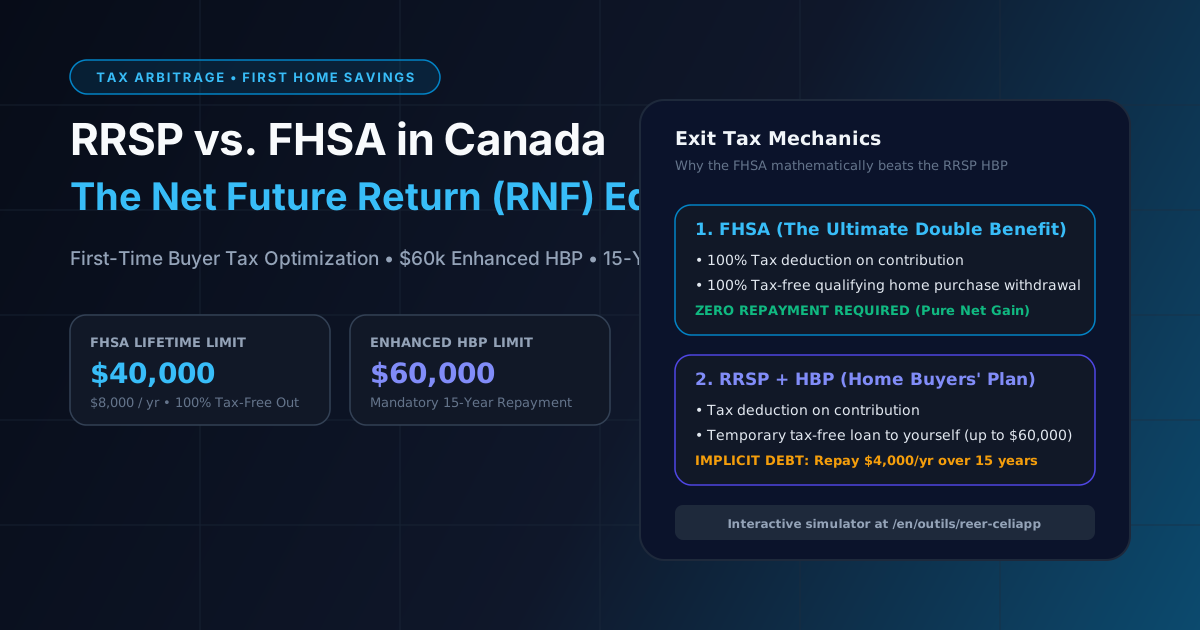
RRSP vs. FHSA in Canada: Mathematical Tax Arbitrage, Marginal Rate Differentials, and the $60,000 Home Buyers' Plan (HBP)
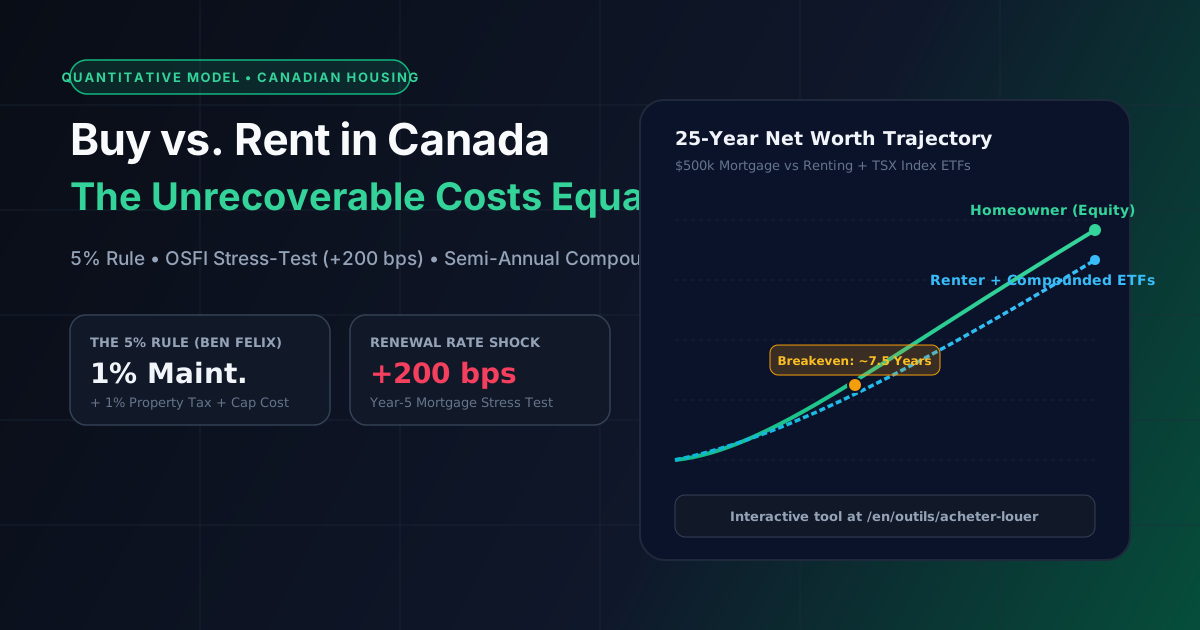
Buy vs. Rent in Canada: The 5% Rule of Unrecoverable Costs, Semi-Annual Compounding, and the +200 bps Renewal Stress Test