RRSP vs. FHSA in Canada: Mathematical Tax Arbitrage, Marginal Rate Differentials, and the $60,000 Home Buyers' Plan (HBP)
Since the introduction of the First Home Savings Account (FHSA / CELIAPP) under the Canadian Income Tax Act and the federal enhancement of the Home Buyers' Plan (HBP / RAP) withdrawal limit from $35,000 to $60,000 per person, Canadian savers face a three-dimensional tax optimization problem between the FHSA, the Registered Retirement Savings Plan (RRSP), and the Tax-Free Savings Account (TFSA).
While conventional retail banking advice repeats simplistic rules of thumb—such as "always max out your RRSP for the tax refund" or "use the HBP to fund your down payment"—actuarial tax mathematics reveals that contributing to an RRSP in the wrong marginal tax bracket, failing to reinvest the tax refund, or triggering an HBP withdrawal without modeling the 15-year after-tax repayment drag can permanently erode $25,000 to $85,000 in household net worth.
In this institutional analysis, we derive the exact algebraic equations governing the FHSA, RRSP, and TFSA, compare combined federal-provincial marginal tax brackets across Quebec, Ontario, British Columbia, and Alberta, quantify the real economic cost of the $60,000 HBP, and demonstrate how a Canadian couple can assemble $200,000+ in tax-optimized down payment capital. You can run your exact income and provincial profile through our Canadian RRSP vs. FHSA Tax Arbitrage Simulator.
1. The Fundamental Tax Arbitrage Equation: FHSA vs. RRSP vs. TFSA
To compare registered accounts rigorously, we must evaluate after-tax purchasing power at the end of an investment horizon $N$, starting from a pre-tax dollar of earned income $C_{\text{gross}}$.
Let:
- $t_0 \in [0, 1)$ be the investor's effective marginal tax rate at the time of contribution (including clawbacks of income-tested benefits such as the Canada Child Benefit where applicable).
- $t_N \in [0, 1)$ be the investor's effective marginal tax rate at the time of withdrawal at horizon $N$ (including Old Age Security—OAS—recovery tax / clawback if applicable).
- $r$ be the annual net return of the underlying investment portfolio (e.g., low-MER index ETFs).
1. The TFSA Equation (After-Tax Contribution, Tax-Free Withdrawal)
Because TFSA contributions are made with after-tax dollars, a pre-tax salary amount $C_{\text{gross}}$ leaves $C_{\text{net}} = C_{\text{gross}}(1 - t_0)$ available to invest inside the TFSA. Over $N$ years of tax-free compounding at rate $r$, with zero tax on withdrawal:
$$VF_{\text{TFSA}} = C_{\text{gross}} \cdot (1 - t_0) \cdot (1 + r)^N$$
2. The RRSP Equation (Pre-Tax Contribution, Fully Taxable Withdrawal)
When you contribute the full pre-tax amount $C_{\text{gross}}$ to an RRSP (or contribute $C_{\text{net}}$ and immediately reinvest the tax refund $C_{\text{gross}} \cdot t_0$), the entire pre-tax principal compounds inside the shelter for $N$ years, and is taxed at the terminal marginal rate $t_N$ upon withdrawal:
$$VF_{\text{RRSP}} = C_{\text{gross}} \cdot (1 + r)^N \cdot (1 - t_N)$$
3. The Theorem of RRSP / TFSA Equivalence and Arbitrage
Comparing $VF_{\text{RRSP}}$ and $VF_{\text{TFSA}}$ reveals the core theorem of Canadian tax planning:
$$\frac{VF_{\text{RRSP}}}{VF_{\text{TFSA}}} = \frac{1 - t_N}{1 - t_0}$$
Three immediate corollaries follow:
- If $t_0 = t_N$ (constant marginal tax rate): $(1 - t_N)/(1 - t_0) = 1$, meaning the RRSP and the TFSA produce the exact same after-tax terminal wealth—provided that $100%$ of the RRSP tax refund is reinvested. The RRSP tax refund is not a free government gift; it is the present value of the deferred tax liability you will owe the CRA (and Revenu Québec) at year $N$.
- If $t_0 > t_N$ (positive tax arbitrage): Contributing at a high marginal tax rate during peak earning years (e.g., $t_0 = 47.5%$) and withdrawing in retirement at a lower marginal rate (e.g., $t_N = 28.0%$) generates a structural tax arbitrage multiplier of: $$\text{Multiplier} = \frac{1 - 0.28}{1 - 0.475} = \frac{0.72}{0.525} = 1.3714 \quad (+37.14% \text{ more net wealth than a TFSA})$$
- If $t_0 < t_N$ (negative tax arbitrage / GIS & OAS trap): Contributing to an RRSP early in your career when your marginal tax rate is low ($t_0 \approx 20%–27%$) and withdrawing later when your income is higher—or when RRSP/RRIF withdrawals trigger the 15% OAS clawback or a 50% Guaranteed Income Supplement (GIS) clawback—destroys after-tax wealth compared to using a TFSA first and saving your RRSP deduction limit for higher-income years.
4. Why the FHSA Is a Mathematical Anomaly ($t_0$ Deduction AND $t_N = 0%$)
The First Home Savings Account (FHSA) combines the upfront tax deduction of an RRSP with the tax-free qualifying withdrawal of a TFSA ($t_N = 0%$ when purchasing a qualifying first home):
$$VF_{\text{FHSA}} = C_{\text{gross}} \cdot (1 + r)^N \cdot (1 - 0) = C_{\text{gross}} \cdot (1 + r)^N$$
Dividing $VF_{\text{FHSA}}$ by $VF_{\text{TFSA}}$ yields:
$$\frac{VF_{\text{FHSA}}}{VF_{\text{TFSA}}} = \frac{1}{1 - t_0}$$
For a Canadian professional in a $45.0%$ combined marginal tax bracket, every pre-tax dollar routed through the FHSA for a first home purchase generates $1 / (1 - 0.45) = 1.8182\times$ (+81.8% more purchasing power) than saving in a TFSA, and completely eliminates the terminal tax liability of an RRSP!
2. FHSA Rules, Carry-Forward Mechanics, and the RRSP Transfer Safety Net
To capture the full value of the FHSA, eligible first-time buyers (defined by the CRA as Canadian residents aged 18 to 71 who have not lived in a qualifying home owned by themselves or their spouse/common-law partner in the current calendar year or the preceding 4 calendar years) must respect four strict statutory parameters:
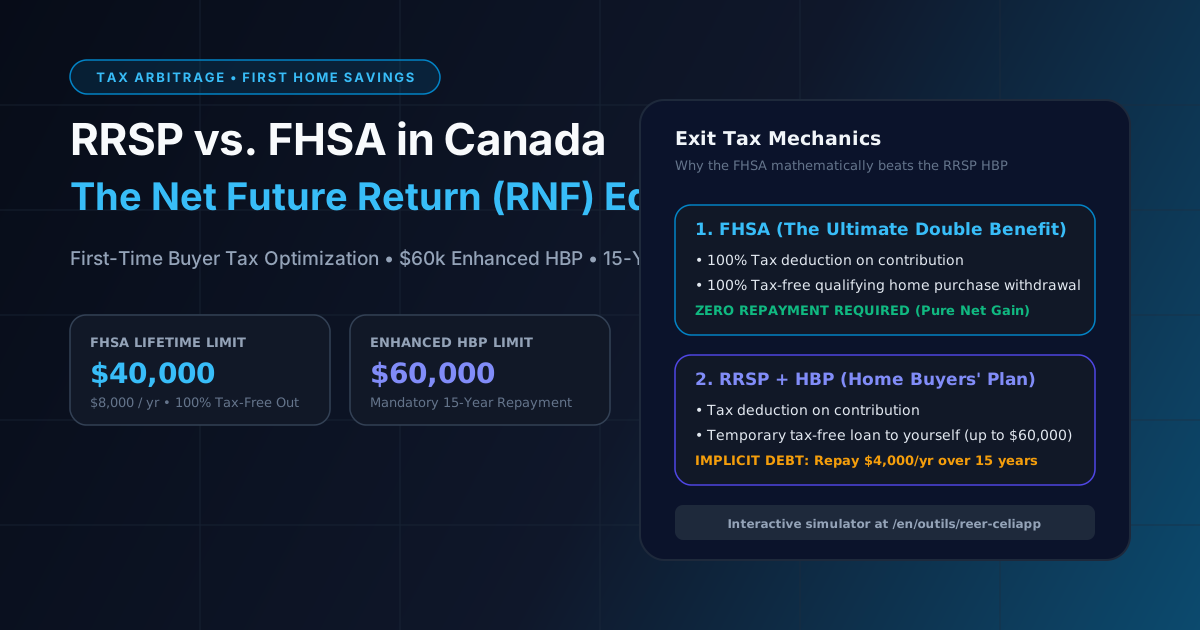
- Annual and Lifetime Limits: $8,000 per year up to a $40,000 lifetime contribution cap (and up to $80,000 per couple).
- The Opening-Year Carry-Forward Trap: Unlike the TFSA (where contribution room accumulates automatically every year from age 18) or the RRSP ($18%$ of prior year's earned income), FHSA contribution room only starts accumulating the calendar year you officially open your first FHSA, and unused carry-forward is strictly capped at $8,000 at any given time. Opening an FHSA today—even with a $50 deposit—immediately unlocks the $8,000 clock so you can contribute $16,000 the following year.
- Deferring the Deduction (Schedule 7 Optimization): Just like an RRSP, you can contribute $8,000 to your FHSA today so your ETFs begin compounding tax-free immediately, while electing on your income tax return to carry forward the tax deduction to a future year when your salary crosses into a higher marginal tax bracket.
- What If You Never Buy a Home?: If you do not purchase a home within 15 years of opening the FHSA (or by age 71), the entire accumulated balance (contributions + $100%$ of investment growth) can be transferred tax-free into your RRSP or RRIF without consuming a single dollar of your regular RRSP contribution room. For lifetime renters, the FHSA effectively acts as $40,000 of bonus RRSP room.
3. Combined Federal + Provincial Marginal Tax Brackets Across Canada (2025–2026)
Our RRSP vs. FHSA Tax Arbitrage Simulator computes exact progressive tax refunds across Canadian provinces. Below is a reference comparison of approximate combined federal-provincial marginal tax rates on ordinary employment income across the four largest provincial tax regimes:
| Taxable Income Tier (CAD) | Quebec (Fed after 16.5% Abatement + QC) | Ontario (Fed + ON + Surtax) | British Columbia (Fed + BC) | Alberta (Fed + AB) |
|---|---|---|---|---|
| $45,000 | $26.53%$ | $20.05%$ | $20.06%$ | $25.00%$ |
| $65,000 | $36.12%$ | $29.65%$ | $28.20%$ | $30.50%$ |
| $95,000 | $37.12%$ | $31.48%$ | $31.00%$ | $30.50%$ |
| $120,000 | $45.71%$ | $43.41%$ | $38.29%$ | $36.00%$ |
| $165,000 | $47.46%$ | $44.97%$ | $40.70%$ | $38.00%$ |
| $250,000+ | $53.31%$ | $53.53%$ | $53.50%$ | $48.00%$ |
Notice the dramatic jump around $115,000–$125,000 in Ontario ($31.48% \to 43.41%$) and Quebec ($37.12% \to 45.71%$). Contributing $8,000 to an FHSA and $12,000 to an RRSP at an income of $130,000 in Quebec or Ontario generates an immediate tax refund of $8,682 to $9,142—capital that can be reinvested directly into your down payment fund.
4. The $60,000 Home Buyers' Plan (HBP): Liquidity Boost vs. 15-Year Repayment Drag
Under the modernized Home Buyers' Plan (HBP / RAP), a first-time buyer can withdraw up to $60,000 from their RRSP ($120,000 for a couple) without immediate withholding tax to buy or build a qualifying home, provided the RRSP contributions have remained in the account for at least 90 days prior to withdrawal.
However, unlike an FHSA withdrawal (which is permanently tax-free and never has to be repaid), an HBP withdrawal is an interest-free loan from your own retirement fund that carries two hidden actuarial costs:
1. The 15-Year Mandatory After-Tax Repayment Schedule
Following the temporary grace period (2 years standard, extended to 5 years for HBP withdrawals made between January 1, 2022, and December 31, 2025), the borrower must repay $1/15\text{th}$ of the withdrawn amount every year for 15 years:
$$\text{Annual HBP Repayment} = \frac{$60,000}{15} = $4,000 \text{ / year} \quad ($333.33 \text{ / month})$$
Crucially, HBP repayments do not generate a new RRSP tax deduction. You must earn pre-tax income of $$4,000 / (1 - t_{\text{future}})$—for example, $6,800 of gross salary at a $41%$ marginal rate—just to deposit $4,000 back into your RRSP each year. If you miss an annual repayment in year $k$, that $4,000 installment is added to your taxable income on Line 12900 of your T1 return, costing you $4,000 \times t_k$ in income tax while permanently burning $4,000 of RRSP room.
2. Opportunity Cost of Lost RRSP Compounding ($\Delta W_{\text{HBP}}$)
While the $60,000 is sitting in residential bricks instead of compounding in global equities inside your RRSP, your retirement portfolio loses 15 years of staggered compounding:
$$\Delta W_{\text{HBP}} = $60,000 (1 + r)^{15} - \sum_{k=1}^{15} $4,000 (1 + r)^{15 - k}$$
At a $7.0%$ annual ETF return over the 15-year repayment period:
- $60,000 left untouched in the RRSP grows to $165,542.
- $4,000 repaid annually over 15 years grows to only $100,516.
- Permanent retirement portfolio drag: −$65,026 in lost pre-tax RRSP wealth!
When Is the $60,000 HBP Still Worth Using?
Despite the repayment drag, the HBP remains highly profitable in two specific scenarios:
- Crossing the 20% Down Payment Threshold (Eliminating CMHC Insurance): If withdrawing $60,000 via the HBP lifts your down payment from $12%$ to $20%$ on a $650,000 purchase, you immediately eliminate the $18,135 CMHC default insurance premium (plus 8%–9% provincial tax in ON/QC) and avoid paying 25 years of mortgage interest on that premium.
- The 90-Day Tax Refund Boost Strategy: If you already hold non-registered cash earmarked for a down payment and have unused RRSP room plus a high marginal tax rate ($t_0 \ge 40%$), depositing up to $60,000 into your RRSP at least 90 days before closing and withdrawing it under the HBP generates an immediate $24,000 to $28,500 tax refund that boosts your down payment at closing.
5. The "$100,000 Individual / $200,000 Couple" Down Payment Architecture
By combining the FHSA and the HBP in the optimal sequence, a first-time buyer (or couple) can assemble a massive tax-optimized down payment over 5 years:
| Component | Single Buyer | Couple (2 First-Time Buyers) | Tax Treatment on Withdrawal |
|---|---|---|---|
| FHSA Contributions (5 years $\times$ $8,000) | $40,000 | $80,000 | 100% Tax-Free — Zero Repayment |
| Compounded FHSA Growth ($5\text{ yrs at } 6%$) | $+$6,396$ | $+$12,792$ | 100% Tax-Free — Zero Repayment |
| RRSP Withdrawal via Enhanced HBP | $60,000 | $120,000 | 0% Withholding Tax — Repay over 15 yrs |
| Total Tax-Sheltered Down Payment Capital | $106,396 | $212,792 | Plus ~$40k–$90k in cumulative tax refunds |
Calculate Your Exact RRSP vs. FHSA Tax Arbitrage
Don't guess your marginal tax rate or your optimal split between FHSA, RRSP, and TFSA. Enter your province, gross income, existing savings, and home purchase timeline into our interactive simulator:
👉 Launch the Canadian RRSP vs. FHSA & $60k HBP Simulator
Once your down payment strategy is locked in, verify your monthly mortgage payment under Canadian semi-annual compounding with our Canadian Mortgage Amortization Calculator and test your housing market's unrecoverable costs with our Buy vs. Rent Stress-Test Calculator.
7 Costly Mistakes with RRSP & FHSA in Canada
Check the items that apply to your strategy to calculate your live Tax Erosion Score and unlock the quantitative optimization protocol.
2 / 7 erosion factors selected
Select the potential friction points in your current setup:
Unlock the Full PDF Guide + Your RRSP / FHSA Action Plan
Enter your email to immediately unlock all 7 quantitative remedies, Net Future Return (RNF) formulas, and download the complete guide.
100% Free · Zero spam · Unsubscribe in 1 click.
2026 Strategic Playbook: Optimizing RRSP + FHSA & Real Estate Tax Arbitrage
The authoritative quantitative manual to maximize your Canadian down payment and net worth: RNF formulas, FHSA ($40,000) vs enhanced $60k HBP tax arbitrage, provincial deduction scheduling, and 1-to-5-year asset allocation frameworks.
Instant digital delivery • Lifetime access & 2026 updates included • Universal formats
From theory to practice
Understand markets and build an allocation: sector versus index ETFs, rebalancing, currency risk and reading market cycles.
Build an ETF planAuthored & Audited by the TrueVerdikt Quantitative Research Team
Financial engineering, Canadian mortgage actuarial modeling & statistical backtest auditing
Every study published on TrueVerdikt is engineered and verified using deterministic mathematical equations, peer-reviewed academic literature, and primary statutory regulations. No financial institution can alter our algorithms or rankings.
Primary Academic & Regulatory References
- • Bailey, D. H., & López de Prado, M. (2014). The Deflated Sharpe Ratio: Correcting for Selection Bias, Backtest Overfitting, and Non-Normality. The Journal of Portfolio Management, 40(5), 94–107.
- • López de Prado, M. (2018). Advances in Financial Machine Learning (Combinatorial Purged Cross-Validation — CPCV). Wiley.
- • Interest Act of Canada (R.S.C., 1985, c. I-15, s. 6) — Semi-Annual Mortgage Compounding & OSFI Guideline B-20 Residential Underwriting.
- • Canadian Securities Administrators (CSA) — National Instrument 81-101 (Fund Facts, MER/TER) & Canada Revenue Agency (CRA — FHSA, RRSP, HBP).
Keep reading
All articles in this section « Macro & rates » →
Buy vs. Rent in Canada: The 5% Rule of Unrecoverable Costs, Semi-Annual Compounding, and the +200 bps Renewal Stress Test
Canadian Mortgage Amortization Explained: Semi-Annual Compounding Mechanics and the Accelerated Bi-Weekly Advantage