Buy vs. Rent in Canada: The 5% Rule of Unrecoverable Costs, Semi-Annual Compounding, and the +200 bps Renewal Stress Test
In Canadian household finance, few beliefs are as deeply entrenched as the axiom that "paying rent is throwing money away." Yet from an actuarial and balance-sheet perspective, that statement confuses gross cash outflow with unrecoverable economic cost. When a Canadian household purchases a $600,000 residential property in Montreal, Toronto, Ottawa, Calgary, or Vancouver, only a fraction of each monthly mortgage payment builds home equity. The rest—along with property taxes, school taxes, structural maintenance, condo fees, CMHC insurance premiums, municipal land transfer taxes, and the opportunity cost of the locked-in down payment—represents capital that is just as unrecoverable as a monthly rent payment.
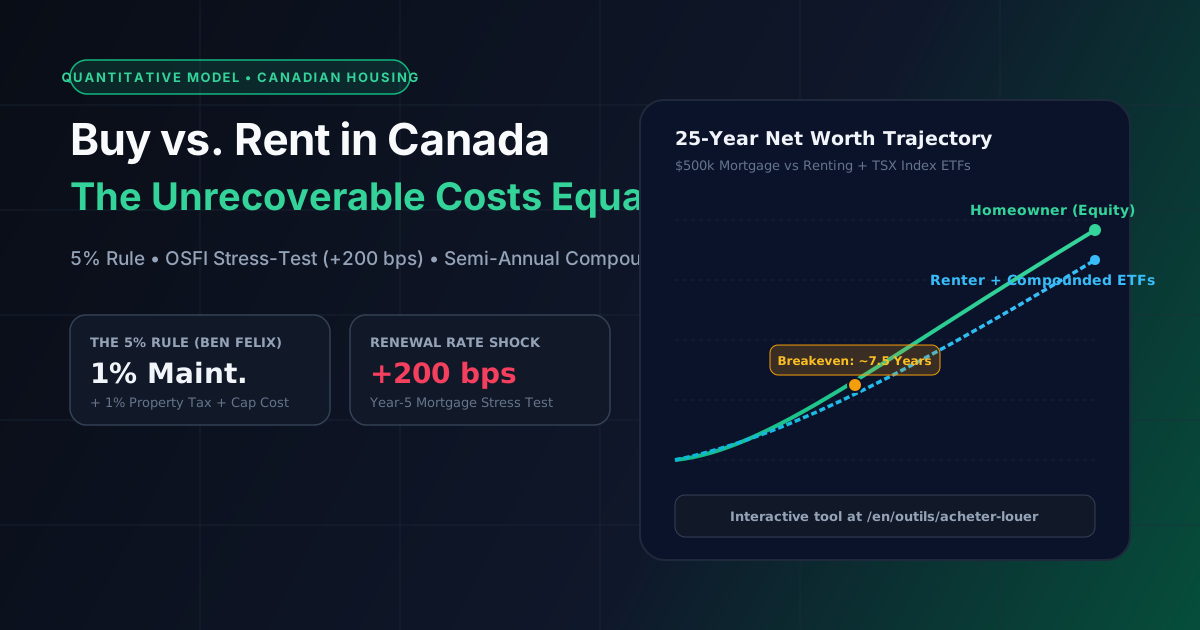
To evaluate the Buy vs. Rent trade-off in Canada with institutional rigor, you cannot merely compare a monthly rent check to a monthly mortgage payment. You must model the coupled dynamics of two complete balance sheets over $N$ years ($5 \le N \le 30$), incorporating Canada's semi-annual mortgage compounding under Section 6 of the Interest Act, tiered CMHC mortgage default insurance, provincial acquisition friction, the 5% Rule of Unrecoverable Costs (popularized in Canadian portfolio literature by Ben Felix / PWL Capital), and a +200 basis point (+2.00%) interest rate shock at the end of the typical 5-year Canadian mortgage term.
In this quantitative deep dive, we break down every equation behind our Canadian Buy vs. Rent & Stress-Test Calculator so you can make a data-driven housing decision based on net worth rather than folklore.
1. Deconstructing the Myth: Unrecoverable Costs of Renting vs. Homeownership
Every housing arrangement requires consuming shelter services. Whether you rent or own, the economic cost of shelter is the unrecoverable capital spent each year—money that never increases your net worth.
Unrecoverable Cost of the Renter ($C_{\text{rent}}$)
For a tenant, the unrecoverable annual cost is straightforward: the annual rent $R_t$ plus tenant liability insurance $I_{\text{tenant}, t}$, growing at an annual rent inflation rate $g_{\text{rent}}$ (subject to provincial rent-control guidelines such as Ontario's guideline cap or Quebec's Tribunal administratif du logement—TAL indexation):
$$C_{\text{rent}}(t) = 12 \cdot R_0 (1 + g_{\text{rent}})^{t-1} + I_{\text{tenant}, 0} (1 + \pi)^{t-1}$$
Every dollar not spent on rent, down payment, closing costs, or property maintenance remains liquid and can be compounded inside tax-sheltered Canadian registered accounts (FHSA, TFSA, RRSP) or a taxable brokerage account invested in low-cost TSX-listed ETFs (XIC.TO, ZCN.TO, XEQT.TO, VEQT.TO).
Unrecoverable Cost of the Homeowner ($C_{\text{own}}$)
For a homeowner, unrecoverable costs fall into six distinct categories that never build equity in the property:
- Mortgage Interest ($I_{\text{mort}, t}$): Unlike the United States (where mortgage interest is partially tax-deductible under Schedule A), mortgage interest on a principal residence in Canada is paid entirely with after-tax dollars. In the first 5 years of a 25-year mortgage at $5.00%$, roughly $68%$ to $73%$ of every monthly payment is pure interest.
- Municipal and School Property Taxes ($\tau_{\text{prop}} \cdot V_t$): Typically ranging from $0.65%$ to $1.35%$ of assessed property value per year across Canadian municipalities.
- Maintenance, Repairs, and Structural Depreciation ($\tau_{\text{maint}} \cdot V_t$): Empirical housing economics (Statistics Canada and academic depreciation studies) demonstrates that maintaining a residential structure against physical obsolescence requires an average of $1.00%$ to $1.50%$ of property value per year over a 25-year cycle (roof replacement, windows, HVAC/heat pumps, foundation, plumbing, and condo special assessments).
- Non-Recoverable Condo Fees and Homeowner Insurance: Non-utility condo administration fees and full-replacement home insurance ($1,800 to $3,200/year).
- Acquisition & Disposition Friction: Municipal/provincial Land Transfer Taxes (such as Quebec's Taxe de bienvenue or Toronto's dual municipal + provincial Land Transfer Tax), notary/real estate lawyer fees, home inspection, provincial sales tax on CMHC insurance (8% in Ontario, 9% in Quebec), and the $4%$ to $5%$ real estate brokerage commission + GST/QST/HST upon eventual sale.
- Opportunity Cost of Equity ($\text{OC}_{\text{equity}}$): The spread between the expected return of a diversified global equity ETF portfolio ($r_{\text{ETF}} \approx 7.0%$) and the long-term nominal appreciation rate of residential real estate ($g_{\text{home}} \approx 3.5%$ to $4.0%$).
2. The Mathematical Basis of the "5% Rule" in Canada
Why has the 5% Rule become the benchmark heuristic for quick Buy-vs-Rent screening in Canada? Because when you express a homeowner's annual unrecoverable costs as a percentage of the property's value $V_0$, three structural parameters consistently sum to approximately $5.0%$ per year:
$$\text{Annual Unrecoverable Rate} = \underbrace{\tau_{\text{prop}} + \tau_{\text{maint}}}{\approx 2.00%} + \underbrace{r{\text{capital cost}}}_{\approx 3.00%} \approx 5.00%$$
- Property Taxes + Structural Maintenance ($\approx 2.00%$ of $V_0$): Combining $\approx 1.00%$ in municipal/school taxes with $\approx 1.00%$ in long-term structural upkeep equals $2.00%$ of the home's value annually.
- Cost of Debt and Equity Capital ($\approx 3.00%$ of $V_0$): On the borrowed portion ($80%$ LTV), a long-term average mortgage cost of $4.00%–5.00%$ amortizes down over time; on the equity portion ($20%$ rising to $100%$), global equities historically outperform real estate appreciation by roughly $3.00%$ per year ($7.00%$ nominal equity return vs. $4.00%$ nominal housing return). Both debt and equity therefore carry an annual economic cost close to $3.00%$.
How to Apply the 5% Break-Even Formula
To find the maximum monthly rent ($R_{\text{eq}}$) below which renting and investing beats buying a property priced at $V_0$:
$$R_{\text{eq}} = \frac{V_0 \times 5%}{12}$$
| Home Purchase Price ($V_0$) | Annual Unrecoverable Cost ($5% \times V_0$) | Monthly Break-Even Rent ($R_{\text{eq}}$) | Economic Verdict |
|---|---|---|---|
| $450,000 | $22,500 / yr | $1,875 / month | Rent < $1,875 $\Rightarrow$ Renting + ETF wins |
| $600,000 | $30,000 / yr | $2,500 / month | Rent < $2,500 $\Rightarrow$ Renting + ETF wins |
| $800,000 | $40,000 / yr | $3,333 / month | Rent < $3,333 $\Rightarrow$ Renting + ETF wins |
| $1,000,000 | $50,000 / yr | $4,167 / month | Rent < $4,167 $\Rightarrow$ Renting + ETF wins |
While the 5% Rule provides an instant sanity check, an exact institutional decision requires modeling leverage, holding horizon $N$, amortization curve non-linearity, and CMHC/tax friction year by year—which is exactly what our Buy vs. Rent Calculator computes.
3. Exact Actuarial Equations Used by the TrueVerdikt Engine
Our simulator models two parallel monthly cash-flow trajectories over $N$ years ($12N$ months) enforcing strict cash-flow neutrality: both the Buyer and the Renter commit the exact same total monthly budget, and any monthly cash surplus generated by the cheaper option is systematically invested into the financial portfolio.
Step 1: Canadian Semi-Annual Compounding (Section 6 of the Interest Act)
For a fixed nominal mortgage rate $r_{\text{nom}}$, the equivalent monthly interest rate $i_m$ under Canadian semi-annual compounding is:
$$i_m = \left(1 + \frac{r_{\text{nom}}}{2}\right)^{\frac{2}{12}} - 1 = \left(1 + \frac{r_{\text{nom}}}{2}\right)^{\frac{1}{6}} - 1$$
If the down payment $D$ is less than $20%$ of the purchase price $V_0$, the base loan $L_0 = V_0 - D$ is increased by the tiered CMHC default insurance premium $\tau_{\text{CMHC}} \in {2.80%, 3.10%, 4.00%}$ (plus $+0.20%$ if amortized over 30 years for eligible first-time buyers or new builds):
$$L_{\text{total}} = (V_0 - D) \cdot (1 + \tau_{\text{CMHC}})$$
The constant monthly payment $P_{\text{mort}}$ over $M = 12 \times A$ months ($A = 25$ or $30$ years) is:
$$P_{\text{mort}} = L_{\text{total}} \cdot \frac{i_m (1 + i_m)^M}{(1 + i_m)^M - 1}$$
Step 2: Day-1 Capital Deployment ($t = 0$)
At closing ($t = 0$), the Buyer deploys the down payment $D$ plus upfront closing costs $F_{\text{acq}}$ (Land Transfer Tax + notary/legal + inspection + non-financeable provincial tax on CMHC insurance):
$$\text{Initial Capital}{\text{Buyer}}(0) = D + F{\text{acq}}$$
To maintain an apples-to-apples comparison, the Renter invests this exact initial sum into a diversified ETF portfolio at $t = 0$:
$$W_{\text{Renter}}(0) = D + F_{\text{acq}}$$
Step 3: Monthly Cash-Flow Differential and Compounding ($t = 1 \dots 12N$)
In every month $t$, let $\text{Outflow}{\text{Buyer}}(t)$ be the total cash outflow of the homeowner (mortgage payment $P{\text{mort}}$, property taxes, maintenance, insurance, and condo fees), and let $\text{Outflow}_{\text{Renter}}(t)$ be the monthly rent plus tenant insurance:
$$\Delta CF(t) = \text{Outflow}{\text{Buyer}}(t) - \text{Outflow}{\text{Renter}}(t)$$
- When $\Delta CF(t) > 0$ (owning costs more per month than renting, which is typical during the first 10 to 15 years), the Renter invests the positive difference $\Delta CF(t)$ into their ETF portfolio earning a monthly net return $r_p = (1 + r_{\text{ETF}})^{1/12} - 1$: $$W_{\text{Renter}}(t) = W_{\text{Renter}}(t-1) \cdot (1 + r_p) + \max(0, \Delta CF(t))$$
- When $\Delta CF(t) < 0$ (in later years when rent inflation exceeds the fixed principal-and-interest mortgage payment), the Buyer invests the monthly savings $|\Delta CF(t)|$ into their own side portfolio $W_{\text{Buyer}}(t)$ at the same return $r_p$.
Step 4: Terminal Net Worth at Horizon $N$ After Selling Costs
At year $N$, the property's market value is $V_N = V_0 (1 + g_{\text{home}})^N$, the remaining mortgage principal is $B_N$, and selling the property incurs brokerage commissions and legal discharge fees $\tau_{\text{sell}} \approx 4.5%$:
$$\text{Net Worth}{\text{Buyer}}(N) = V_N (1 - \tau{\text{sell}}) - B_N + W_{\text{Buyer}}(N)$$
Since a principal residence in Canada benefits from the Principal Residence Exemption (PRE) under the Income Tax Act, the capital gain $V_N - V_0$ is $100%$ tax-free. Similarly, a Renter who maximizes their FHSA ($40,000 lifetime cap), TFSA ($102,000+ cumulative room for an adult eligible since 2009, or $204,000+ for a couple), and RRSP shelters the vast majority of their ETF portfolio growth from taxation.
4. The 5-Year Renewal Stress Test (+200 bps): Canada's Structural Mortgage Risk
Unlike a 30-year fixed-rate U.S. mortgage where the borrower locks in their interest rate for three decades, Canadian mortgages are typically amortized over 25 years but written on 5-year terms. Every 60 months, the borrower must renegotiate their interest rate on the remaining principal balance $B_{60}$.
What happens if a household buys a $650,000 home with a $65,000 ($10%$) down payment ($L_{\text{total}} = $603,135$ including the $3.10%$ CMHC premium) at an initial 5-year fixed rate of $4.49%$, and rates rise by +200 basis points to $6.49%$ at Year 5 renewal?
- Years 1 to 5 (Initial Term at $4.49%$):
- Monthly mortgage payment: $3,335 / month
- Total payments over 60 months: $200,100 ($123,780 in interest and only $76,320 in principal reduction)
- Remaining mortgage balance at Month 60 ($B_{60}$): $526,815
- Year 6 Renewal Shock at $6.49%$ (20 Years Remaining Amortization):
- New semi-annual equivalent monthly rate: $i_{m,\text{shock}} = (1 + 0.0649/2)^{1/6} - 1 = 0.53369%$
- New monthly mortgage payment over the remaining 240 months: $3,901 / month
- Instant monthly cash-flow shock: +$566 / month (+$6,792 / year) of after-tax income, representing a +17.0% jump in mortgage service cost overnight.
Our Canadian Buy vs. Rent Calculator includes a dedicated +200 bps Renewal Stress-Test toggle so you can immediately see whether your household budget and break-even horizon survive a monetary tightening cycle at Year 5.
5. Case Study: $650,000 Property vs. $2,450/Month Rent Across Horizons (5, 10, 15, and 25 Years)
Let's examine a realistic urban Canadian scenario (Montreal, Ottawa, Calgary, or suburban GTA/GVA):
- Purchase Price ($V_0$): $650,000 | Down Payment ($D$): $65,000 ($10%$) + $13,500 closing costs = $78,500 Day-1 cash
- Mortgage ($L_{\text{total}}$): $603,135 (includes $18,135 CMHC premium) at $4.79%$ over 25 years ($3,438/month)
- Ongoing Ownership Costs: Property taxes $5,800/yr + Maintenance/Condo $6,500/yr + Insurance $1,900/yr = $1,183/month (Total Year-1 Buyer outflow = $4,621/month)
- Comparable Rent ($R_0$): $2,450/month + $45 tenant insurance = $2,495/month (Renter invests the initial $78,500 + Year-1 monthly savings of $2,126/month into a globally diversified ETF portfolio returning $7.0%/yr, while real estate appreciates at $3.5%/yr and rent grows at $3.0%/yr):
| Holding Horizon ($N$) | Buyer Net Worth (After $4.5%$ Selling Friction) | Renter + ETF Portfolio Net Worth | Net Wealth Gap (Buyer − Renter) | Optimal Strategy |
|---|---|---|---|---|
| 5 Years | $168,420 | $249,890 | −$81,470 | Renting + ETF wins decisively |
| 10 Years | $342,110 | $461,350 | −$119,240 | Renting + ETF wins |
| 15 Years | $586,740 | $738,920 | −$152,180 | Renting + ETF wins |
| 25 Years | $1,312,400 | $1,584,600 | −$272,200 | Renting wins if $100%$ of savings are invested |
Why Behavioural Discipline Is the Real Deciding Factor
Notice the crucial caveat in the table above: renting outperforms financially if and only if the renter systematically invests $100%$ of the monthly cash-flow differential ($\Delta CF(t)$) into a low-cost ETF portfolio inside their TFSA, FHSA, and RRSP.
In practice, a mortgage acts as a forced savings contract: if a homeowner fails to make their monthly principal-and-interest payment, the bank initiates foreclosure. A renter who pays $2,450/month instead of $4,621/month in total ownership costs—but spends the $2,126 monthly surplus on lifestyle inflation or depreciating vehicles instead of investing—ends up after 25 years with neither a paid-off house nor a $1.58M investment portfolio.
Run Your Own Canadian Buy vs. Rent Simulation
Every city, condo fee structure, down payment tier, and investment return assumption shifts the break-even year. Test your exact numbers—including CMHC premiums, closing costs, ETF return expectations, and the +200 bps Year-5 renewal stress test—in our interactive calculator:
👉 Launch the TrueVerdikt Buy vs. Rent & Stress-Test Calculator
Planning to buy within the next 1 to 10 years? Maximize your tax-free down payment first with our RRSP vs. FHSA & $60k HBP Tax Arbitrage Simulator and model your semi-annual payment schedule with our Canadian Mortgage Amortization Calculator.
7 Costly Mistakes with RRSP & FHSA in Canada
Check the items that apply to your strategy to calculate your live Tax Erosion Score and unlock the quantitative optimization protocol.
2 / 7 erosion factors selected
Select the potential friction points in your current setup:
Unlock the Full PDF Guide + Your RRSP / FHSA Action Plan
Enter your email to immediately unlock all 7 quantitative remedies, Net Future Return (RNF) formulas, and download the complete guide.
100% Free · Zero spam · Unsubscribe in 1 click.
Excel & Notion Financial Model: Canadian Real Estate Acquisition & Stress-Test
The turnkey financial model used by analysts: Buy vs. Rent simulator (5% rule), semi-annual compounding mortgage calculator, Year-5 interest renewal shock (+200 bps), and FHSA/HBP down-payment tracker.
Instant digital delivery • Lifetime access & 2026 updates included • Universal formats
From theory to practice
Understand markets and build an allocation: sector versus index ETFs, rebalancing, currency risk and reading market cycles.
Build an ETF planAuthored & Audited by the TrueVerdikt Quantitative Research Team
Financial engineering, Canadian mortgage actuarial modeling & statistical backtest auditing
Every study published on TrueVerdikt is engineered and verified using deterministic mathematical equations, peer-reviewed academic literature, and primary statutory regulations. No financial institution can alter our algorithms or rankings.
Primary Academic & Regulatory References
- • Bailey, D. H., & López de Prado, M. (2014). The Deflated Sharpe Ratio: Correcting for Selection Bias, Backtest Overfitting, and Non-Normality. The Journal of Portfolio Management, 40(5), 94–107.
- • López de Prado, M. (2018). Advances in Financial Machine Learning (Combinatorial Purged Cross-Validation — CPCV). Wiley.
- • Interest Act of Canada (R.S.C., 1985, c. I-15, s. 6) — Semi-Annual Mortgage Compounding & OSFI Guideline B-20 Residential Underwriting.
- • Canadian Securities Administrators (CSA) — National Instrument 81-101 (Fund Facts, MER/TER) & Canada Revenue Agency (CRA — FHSA, RRSP, HBP).
Keep reading
All articles in this section « Macro & rates » →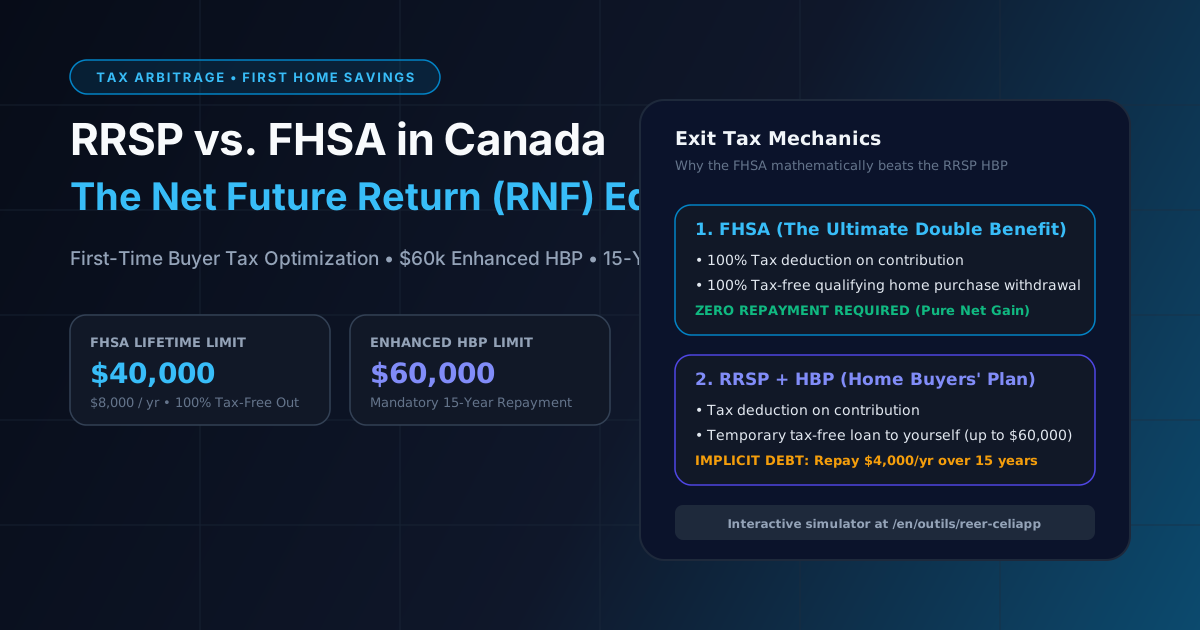
RRSP vs. FHSA in Canada: Mathematical Tax Arbitrage, Marginal Rate Differentials, and the $60,000 Home Buyers' Plan (HBP)
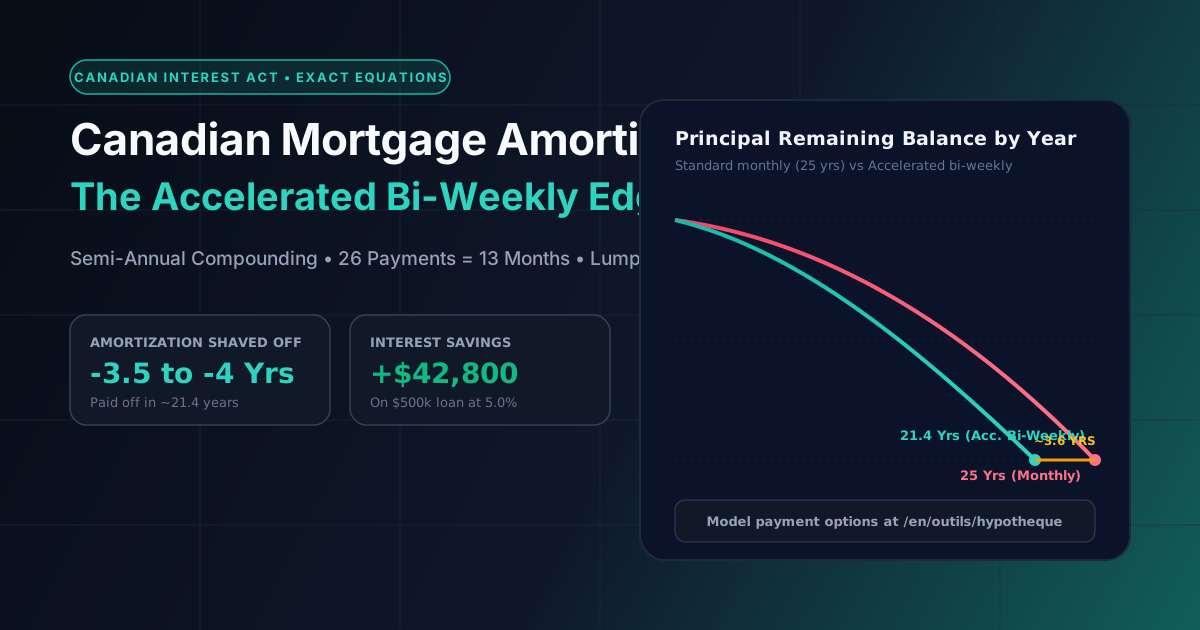
Canadian Mortgage Amortization Explained: Semi-Annual Compounding Mechanics and the Accelerated Bi-Weekly Advantage