Investing in Anthropic (Nasdaq: ANT) from Canada Post-IPO: $81B Listing Analysis, USD Access, and Risk Math
Post-IPO financial analysis of Anthropic (Nasdaq: ANT) for Canadian investors: record $81B IPO priced at $83 on Nov 18, +17% debut to $97.17 on Nov 19, -9% to -11% pullback on Nov 20, USD FX costs, and AMF/CIRO framework.
Last methodological review:

Quantitative Research · Quant Lab
ETF Allocation Planner
Editorial illustration — TrueVerdikt
IN THIS ARTICLE
Key Takeaways (TL;DR)
- Anthropic has been publicly traded on the Nasdaq under ticker ANT since November 19, 2026, following a record USD 81 billion IPO priced at USD 83 per share on November 18.
- Shares surged +17% to USD 97.17 on debut day before dropping 9% to 11% back toward ~USD 83 on November 20, underscoring extreme post-IPO price-discovery volatility.
- Canadian investors can now hold ANT directly in USD inside an RRSP, TFSA, or FHSA, but with no Canadian CDR at launch, controlling FX conversion spreads (1.5%–2.5% vs. Norbert's Gambit) is critical.
- Pre-IPO private SPVs are now obsolete for new capital; indirect routes (AMZN, GOOGL, AI/Cloud ETFs) remain relevant to buffer single-stock volatility and the upcoming 180-day lock-up expiry.
The long-awaited market debut of Anthropic PBC reshaped global equity markets this week. On November 18, 2026, the developer of the Claude artificial intelligence model family priced its Initial Public Offering (IPO) at USD 83.00 per share, raising a record USD 81 billion. When shares began trading on the Nasdaq under ticker ANT on November 19, 2026, the stock rallied +17% to USD 97.17, only to reverse sharply by -9% to -11% on November 20, 2026, sliding back toward its ~USD 83 offering price amid a broad global AI sell-off.
For Canadian investors, Anthropic's transition from private Delaware Public Benefit Corporation to Nasdaq-listed issuer fundamentally alters portfolio access. Investors no longer need to navigate illiquid private Special Purpose Vehicles (SPVs) restricted to Accredited Investors under National Instrument 45-106. Instead, ANT is directly tradable in USD inside Canadian RRSP, TFSA, FHSA, and non-registered brokerage accounts. Yet immediate liquidity brings new quantitative trade-offs: CAD/USD FX fee drag (no Canadian CDR exists at launch), post-IPO drawdown math, 180-day insider lock-up supply, and how direct ownership compares against Amazon (AMZN), Alphabet (GOOGL), and diversified AI/Cloud ETFs.
To model long-term fee drag across vehicles or stress-test a high-volatility allocation within your overall portfolio, explore our Canadian Fund & ETF Comparator and Investment Plan Simulator.
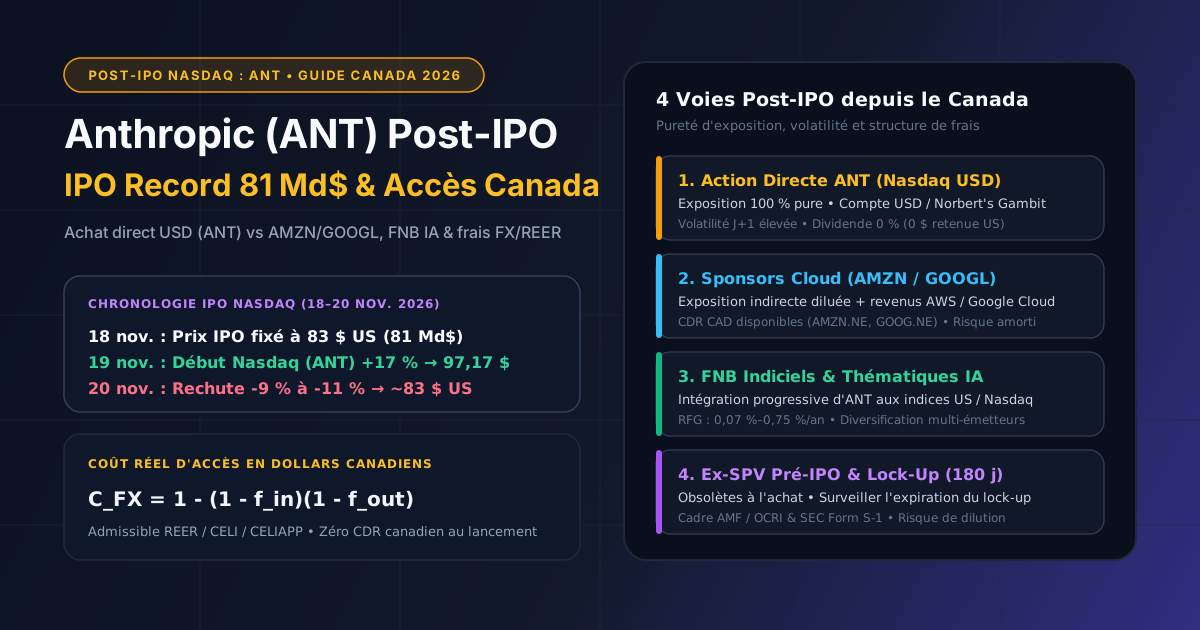
1. Financial Anatomy of Anthropic's Record $81B IPO (Nov 18–20, 2026)
Anthropic's USD 81 billion listing offers a textbook study in post-IPO price discovery for capital-intensive frontier technology:
- November 18, 2026 (Pricing): Offering priced at USD 83.00/share, balancing extraordinary institutional demand against scrutiny over multi-billion-dollar data-center compute commitments.
- November 19, 2026 (Day 1 on Nasdaq): Strong opening surge to USD 97.17 (+17.07%) as retail accounts and thematic growth funds chased pure-play frontier LLM exposure.
- November 20, 2026 (Day 2 Reversal): Rapid -9% to -11% decline back toward ~USD 83, amplified by rapid profit-taking and broader semiconductor governance headlines surrounding NVIDIA (SEC accounting inquiry reported by Reuters the same day).
Mathematically, a Canadian retail investor who chased ANT near the Day-1 high () and watched it retrace to the very next session immediately faced a drawdown. Recovering to breakeven requires a gain of:
If that same order was funded through an automatic Canadian brokerage CAD USD conversion charging , the effective CAD breakeven hurdle jumps above +19.4% before accounting for CAD/USD exchange-rate movements.

2. Evaluating the 4 Post-IPO Access Pathways from Canada
Anthropic's Nasdaq listing reshapes the four pathways available to Canadian investors.
Pathway 1: Direct Ownership of Anthropic (ANT on Nasdaq in USD)
Buying ANT directly delivers 100% pure-play exposure to Claude enterprise subscriptions, API revenues, and Anthropic's unit-economics trajectory.
- Registered Account Eligibility: Because the Nasdaq is a designated stock exchange under the Canadian Income Tax Act,
ANTqualifies for RRSP, TFSA, and FHSA accounts. Since Anthropic pays no dividend at launch (reinvesting all capital into compute and R&D), the 15% U.S. dividend withholding tax equals $0 across every Canadian account type. - FX Conversion Friction: Unlike NVIDIA (
NVDA.NE), Amazon (AMZN.NE), or Alphabet (GOOG.NE),ANThas no CAD-hedged Canadian Depositary Receipt (CDR) at launch. Buying it via automatic brokerage FX conversion (1.5% to 2.5% per leg) triggers a compounded round-trip FX cost:
At , pure currency friction destroys 3.96% of capital. Funding a dual-currency USD sub-account via Norbert's Gambit (DLR.TO / DLR.U.TO) or using a spot-FX brokerage reduces total conversion costs to ~0.15%–0.30% for allocations above ~CAD 1,500.
Pathway 2: Strategic Cloud Backers (Amazon AMZN and Alphabet GOOGL)
Prior to November 19, Amazon (~USD 8B committed) and Alphabet (>USD 3B committed) served as indirect proxies. Post-IPO, their analytical role shifts to buffered exposure: combining a now mark-to-market public stake in ANT with recurring cloud infrastructure revenues (AWS Bedrock / Trainium and Google Cloud TPU).
Direct balance-sheet sensitivity remains diluted by each hyperscaler's massive market capitalization :
Even with Anthropic valued near USD 81 billion publicly, a post-dilution 10%–15% equity stake inside a USD 2+ trillion conglomerate represents roughly 0.4% to 0.6% of the sponsor's market cap. In exchange for lower purity, however, AMZN and GOOGL offer CAD-hedged CDRs (AMZN.NE, GOOG.NE) and far lower volatility than a newly listed single-stock IPO.
Pathway 3: Broad Index ETFs and Thematic AI / Cloud ETFs
Broad Canadian-listed U.S. equity ETFs (such as XUU, VFV, or ZNQ) do not immediately hold a newly listed IPO on Day 1; index providers enforce seasoning periods and profitability or liquidity screens before quarterly inclusion. Thematic AI/Cloud or IPO-focused ETFs may add ANT faster, though typically at elevated MERs of 0.40% to 0.75% per year.
Pathway 4: Legacy Pre-IPO SPVs and the 180-Day Lock-Up Overhang
For new Canadian capital, private secondary SPVs (which charged 3%–5% upfront, 2% annual management fees, and 20% carried interest under NI 45-106) are now economically obsolete: paying multi-layer private fees makes no sense once liquid Nasdaq shares trade daily.
However, pre-IPO venture funds, employees, and legacy SPVs remain bound by standard 180-day post-IPO lock-up agreements (extending into May 2027), as disclosed in Anthropic's SEC Form S-1 registration statement. Anticipating potential supply expansion around lock-up expiration is a classic risk-management discipline for post-IPO equities.
3. Post-IPO Comparative Matrix for Canadian Investors
| Evaluation Dimension (Nov 2026) | 1. Direct ANT (Nasdaq) |
2. Backers (AMZN / GOOGL) |
3. AI / Cloud & Index ETFs | 4. Legacy Pre-IPO SPVs |
|---|---|---|---|---|
| Market Status (Nov 20, 2026) | Listed on Nasdaq (~USD 83) | Listed (Nasdaq + CAD CDRs) | Listed (TSX / U.S. Exchanges) | Obsolete for new purchases |
| Anthropic Exposure Purity | 100% direct | Low (<1% balance sheet + Cloud) | Gradual / diluted | 100% gross (eroded by fees) |
| Canadian Account Eligibility | RRSP, TFSA, FHSA (USD) | RRSP, TFSA, FHSA (USD/CAD) | RRSP, TFSA, FHSA | Ineligible (exempt market) |
| Primary Cost Drag | FX Spread (0.15% NG to 2.5%) | 0% (or CDR ~0.60%/yr) | MER: 0.07% to 0.75%/yr | 3–5% entry + 2%/yr + 20% carry |
| 15% U.S. Dividend Tax | $0 (zero dividend) | $0 (AMZN) / minimal (GOOGL) | 0% in RRSP (U.S. ETF) / 15% TFSA | N/A |
| Dominant Risk Factor | Post-IPO volatility + 180d lock-up | Conglomerate / antitrust risk | Overlap & thematic MER drag | Residual lock-up illiquidity |
4. Post-IPO Valuation, Compute CapEx, and CSA/CIRO Oversight
Even as a public company, a frontier AI issuer exhibits extreme valuation sensitivity to gross margins and data-center capital expenditure (CapEx). Under a discounted Free Cash Flow framework, intrinsic enterprise value hinges on how rapidly recurring software revenue outpaces compute infrastructure outlays:
That sensitivity to directly explains why ANT dropped -9% to -11% on November 20, 2026: any reassessment of chip depreciation schedules or enterprise AI return on investment compresses valuation multiples immediately.
From a Canadian regulatory standpoint, Anthropic's Nasdaq listing moves investors out of provincial exempt-market rules (National Instrument 45-106, overseen by the CSA/AMF) and into full SEC public reporting (Form 10-Q, Form 10-K, and Form 4 insider filings). Canadian investors should remain alert to social-media scams offering "discounted post-IPO ANT allocations" outside registered CIRO dealers—legitimate ANT shares trade exclusively through regulated brokerages connected to the Nasdaq.

5. Position Sizing and Execution Discipline
When a newly listed mega-cap swings +17% on Day 1 and -9% to -11% on Day 2, quantitative risk discipline matters far more than headlines:
- Audit FX and MER drag first: Compare multi-year fee compounding across direct USD holdings and ETFs in our Canadian Fund & ETF Comparator.
- Cap single-stock risk budgets: Model how a -40% to -50% post-IPO drawdown impacts your long-term net worth using the Investment Plan Simulator.
- Use limit orders exclusively: During early post-IPO sessions, wide bid-ask spreads and opening auction gaps can silently add dozens of basis points of slippage to market orders.

Primary Sources and Regulatory Filings
- U.S. Securities and Exchange Commission (SEC) — EDGAR — Anthropic PBC Form S-1 Registration Statement (IPO terms, compute CapEx risk factors, share structure, and 180-day lock-up provisions).
- Nasdaq, Inc. — Anthropic PBC (ANT) Listing & Initial Trading Summary (November 18–20, 2026: USD 83 IPO pricing, USD 81B offering size, and USD 97.17 Day-1 peak).
- Reuters (November 18–20, 2026) — Reporting on Anthropic's record USD 81 billion IPO and the November 20 post-IPO pullback amid global AI equity volatility.
- Canadian Securities Administrators (CSA) / CIRO — Investor Guidance on U.S.-Listed Equities, Designated Exchanges, and Registered Dealer Verification.
Analytical Disclaimer: This article is provided strictly for educational and quantitative informational purposes. It does not constitute personalized financial, tax, or legal advice, nor a recommendation to buy or sell shares of Anthropic (ANT), Amazon (AMZN), or Alphabet (GOOGL).
ETF Allocation Planner
Project deterministic ETF contribution ranges and structure asset classes across tax wrappers.
Open ETF PlannerIndependent financial engineer based in Quebec, Canada, Alain Legrand builds and audits TrueVerdikt's deterministic models: Series A/F mutual fund vs. TSX ETF fee comparisons, RRSP/FHSA tax arbitrage, Canadian mortgage actuarial schedules, and statistical overfitting detection (Deflated Sharpe Ratio & CPCV).
Primary Regulatory & Academic Sources
- OSFI — Guideline B-20 (Residential Mortgage Underwriting) — Residential mortgage underwriting practices, procedures, and minimum qualifying rate stress-test.
- CRA — FHSA, RRSP & Home Buyers' Plan — Official contribution limits ($8,000/yr, $40,000 lifetime FHSA cap), tax deductions, and HBP repayment rules.
- CIFSC — Canadian Investment Funds Standards Committee — Standardized classification of Canadian mutual funds and ETFs used across our MER fee comparator.
- Bailey & López de Prado (2014) — The Deflated Sharpe Ratio — Correcting for Selection Bias, Backtest Overfitting, and Non-Normality. The Journal of Portfolio Management, 40(5), 94–107 (SSRN).
Keep reading
All articles in this section « Macro & rates » →
Circular AI Financing, CUDA vs. TPU/Trainium, and Risk Parity: Auditing Global Portfolio Exposure

Buying NVIDIA (NVDA) & Anthropic (ANT) in USD from Canada: FX Fees, Norbert's Gambit, CDRs, and RRSP/TFSA Tax Rules
