Buying NVIDIA (NVDA) & Anthropic (ANT) in USD from Canada: FX Fees, Norbert's Gambit, CDRs, and RRSP/TFSA Tax Rules
Exact math of CAD/USD FX erosion (1.5%–2.5%) for buying NVDA or Anthropic (Nasdaq: ANT) from Canada, round-trip cost and breakeven equations, NVDA.NE CDR vs. Norbert's Gambit (DLR/DLR.U), and 15% U.S. withholding tax rules.
Last methodological review:

Quantitative Research · Quant Lab
ETF Allocation Planner
Editorial illustration — TrueVerdikt
IN THIS ARTICLE
Key Takeaways (TL;DR)
- Converting CAD to USD through a standard Canadian retail brokerage typically costs 1.5% to 2.5% per leg, creating a compounded round-trip FX drag of 2.98% to 4.94%.
- The Canadian-listed CDR NVDA.NE (Cboe Canada) eliminates upfront FX conversion fees but carries an embedded currency-hedging cost of up to 0.60% per year.
- For allocations above ~CAD 1,500 held longer than 2 years, Norbert's Gambit (DLR.TO / DLR.U.TO) inside a USD account mathematically outperforms both brokerage FX and CDRs.
- Under Article XXI of the Canada–U.S. Tax Treaty, holding USD-listed NVDA in an RRSP exempts dividends from the 15% U.S. withholding tax, whereas TFSAs and FHSAs are not exempt.
When a Canadian investor buys individual shares of NVIDIA Corporation (Nasdaq: NVDA)—or, following its record November 19, 2026 IPO, Anthropic PBC (Nasdaq: ANT)—the first quantitative hurdle is not market timing, but CAD/USD currency conversion mechanics and account-type tax location. At many Canadian retail brokerages, overlooking foreign-exchange spreads immediately erodes 3% to 5% of invested capital before the stock even moves.
Canadian investors have three primary ways to hold direct U.S. AI equity exposure: automatic brokerage FX conversion, a CAD-hedged Canadian Depositary Receipt (NVDA.NE on Cboe Canada—noting that newly listed ANT has no Canadian CDR at launch), and low-cost USD conversion inside a dual-currency account via Norbert's Gambit (using DLR.TO / DLR.U.TO). This guide derives the exact compounded cost and breakeven equations for each method, followed by a breakdown of the 15% U.S. dividend withholding tax across RRSPs, TFSAs, and FHSAs.
To model long-term fee drag or optimize registered-account allocation across Canada, explore our Canadian Fund & ETF Comparator and RRSP vs. FHSA Tax Arbitrage Simulator.
1. The Math of Brokerage FX Erosion in Canada
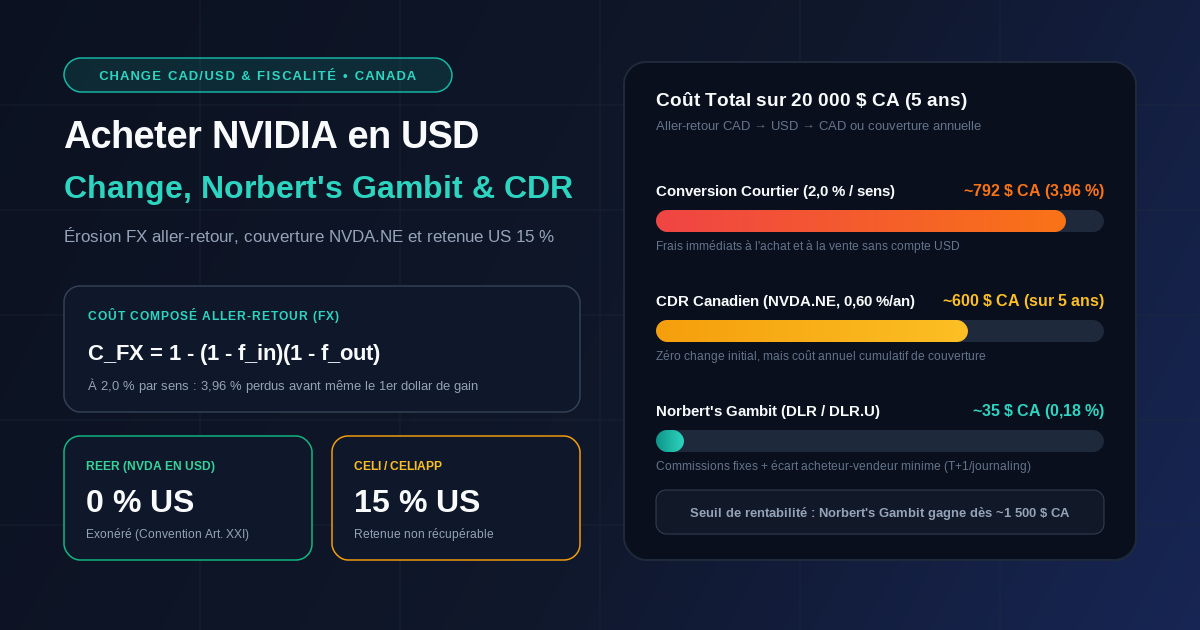
Most "zero-commission" Canadian brokerage platforms advertise CAD 0 equity trades while quietly charging a 1.50% to 2.50% foreign-exchange markup above the interbank spot rate on every CAD USD purchase—and again on the USD CAD conversion when selling (if the account does not hold USD cash balances).
Letting denote the entry FX fee and the exit FX fee, the compounded round-trip FX cost on initial capital is:
At a typical brokerage charging :
On a CAD 20,000 allocation, automatic brokerage FX conversion immediately costs roughly CAD 792 in pure currency friction. Worse still, if an investor without a USD sub-account rebalances or rotates U.S. holdings twice per year, the hurdle rate required merely to break even exceeds 7% to 8% annually.

2. The NVDA.NE Canadian CDR: CAD Convenience vs. Compounding Hedging Drag
Canadian Depositary Receipts (CDRs) issued by CIBC and traded in Canadian dollars on Cboe Canada (formerly NEO Exchange)—such as NVDA.NE—let Canadians buy fractional NVIDIA exposure in CAD without opening a USD account or paying brokerage FX markups.
However, two quantitative features govern multi-year CDR ownership:
- Embedded daily currency hedging: The CDR's share-conversion ratio adjusts daily to neutralize CAD/USD exchange-rate fluctuations. Per the official CIBC CDR prospectus, the issuer embeds a currency-hedging spread of up to 0.60% per year directly into the daily ratio calculation (meaning it never appears as a separate fee line on brokerage statements).
- Multi-year compounding cost: Unlike a one-time USD conversion fee, an ongoing hedging drag compounds every year the position is held:
Over a -year holding period at :
Over years, the cumulative hedging drag reaches 5.84%—surpassing even a traditional brokerage's one-time FX markup. Consequently, NVDA.NE is most efficient for small dollar allocations (under ~CAD 1,500), short holding periods, or investors who explicitly want CAD currency hedging.
3. Norbert's Gambit (DLR.TO / DLR.U.TO) and Exact Breakeven Math
Norbert's Gambit is a standard, fully legal conversion method used by Canadian investors with dual-currency (CAD/USD) brokerage accounts to convert funds near the interbank spot rate. It uses an interlisted TSX ETF that trades in both currencies—most commonly the Global X US Dollar Currency ETF (DLR.TO in CAD and DLR.U.TO in USD):
- Buy shares of
DLR.TOusing Canadian dollars. - Request that your brokerage journal the shares from the CAD ticker (
DLR.TO) to the USD ticker (DLR.U.TO), which typically settles in 2 to 5 business days (some brokers now charge a flat journaling fee of CAD 0 to CAD 10). - Sell
DLR.U.TOto settle USD cash directly into your USD sub-account, then purchaseNVDAon the Nasdaq.
The total dollar cost of Norbert's Gambit for an amount equals fixed execution fees (trade commissions plus any journaling fee, typically CAD 10 to CAD 25 combined) plus the bid-ask spread on DLR (roughly 0.10% to 0.15%):
Setting Norbert's Gambit equal to a brokerage's percentage FX fee () yields the exact breakeven conversion size :
Using , a brokerage FX fee of ($0.015$), and a spread ($0.0015$):
Above roughly CAD 1,500, Norbert's Gambit delivers immediate net savings—cutting a CAD 20,000 one-way conversion from CAD 300–500 down to roughly CAD 35–45.
4. Quantitative Cost Comparison (CAD 20,000 Position Over 5 Years)
| Financial & Operational Metric | Brokerage FX (2.0%/leg) | Canadian CDR (NVDA.NE) |
Norbert's Gambit (DLR / DLR.U) |
Native Spot-FX Broker (e.g., IBKR) |
|---|---|---|---|---|
| Trading Currency | USD (no USD hold) | CAD (FX-hedged) | USD (USD sub-account) | USD (interbank spot) |
| Upfront CAD → USD Cost | ~CAD 400 (2.0%) | CAD 0 | ~CAD 25–35 (~0.15%) | ~CAD 3 (USD 2 min.) |
| Ongoing Annual Fee Drag | 0% | Up to 0.60%/yr | 0% | 0% |
| Estimated 5-Year Round-Trip Cost | ~CAD 792 (3.96%) | ~CAD 600 (~2.96%) | ~CAD 50–70 (~0.30%) | ~CAD 6 (~0.03%) |
| Execution Settlement | Instant | Instant | 2 to 5 business days (journaling) | Instant |
| CAD/USD Currency Exposure | Unhedged (USD) | Hedged (CAD neutral) | Unhedged (USD) | Unhedged (USD) |
| Optimal Analytical Use Case | Avoid above CAD 1,000 | Small tickets / short term / FX hedge | Large allocations + long term (RRSP/TFSA) | Active multi-currency investors |
5. U.S. Dividend Withholding Tax (15%): RRSP vs. TFSA and FHSA
Beyond FX costs, holding U.S. equities in Canada is governed by Article XXI of the Canada–U.S. Tax Treaty and Canada Revenue Agency (CRA) rules. The IRS levies a statutory 30% withholding tax on U.S.-source dividends paid to non-residents, reduced to 15% once a valid Form W-8BEN is filed with your Canadian brokerage:
- Inside an RRSP (or RRIF): The IRS explicitly recognizes the RRSP as a treaty-exempt retirement account under Article XXI. Dividends paid by USD-listed
NVDAheld directly in an RRSP face 0% U.S. withholding tax. - Inside a TFSA or FHSA: Neither the TFSA nor the FHSA is recognized as a retirement account under Article XXI. Consequently, U.S. dividends paid inside a TFSA or FHSA are subject to an unrecoverable 15% U.S. withholding tax (no foreign tax credit can be claimed inside tax-free accounts).
- Inside a Non-Registered Account: The 15% U.S. withholding tax applies, but Canadian residents can generally claim a Foreign Tax Credit on their Canadian tax return to avoid double taxation; however, realized capital gains remain taxable in Canada.
NVIDIA & Anthropic (ANT) quantitative nuance: Unlike high-dividend U.S. stocks yielding 3% to 5%, NVIDIA's dividend yield is historically tiny (under 0.05% annually) and Anthropic (ANT) pays 0% dividends post-IPO. Losing 15% of a 0.05% dividend inside a TFSA equates to less than 0.008% per year—under CAD 2 annually on a CAD 20,000 NVDA position—and exactly CAD 0 on ANT. Crucially, capital gains are 100% exempt from U.S. withholding tax across RRSPs, TFSAs, and FHSAs alike, and the absence of a Canadian CDR for ANT makes Norbert's Gambit even more essential for avoiding retail brokerage FX spreads.
To compare registered-account contribution strategies across Canadian marginal tax brackets, run scenarios in our RRSP vs. FHSA Tax Arbitrage Simulator and evaluate ETF cost structures in the Canadian Fund & ETF Comparator.

Primary Sources and Regulatory Filings
- Department of Finance Canada / Canada Revenue Agency (CRA) — Canada–United States Income Tax Convention (Article XXI — Exempt Organizations) and Foreign Tax Credit guidance (Form W-8BEN / T2209).
- CIBC World Markets Inc. / Cboe Canada — Canadian Depositary Receipts (CDR — NVDA.NE) Prospectus & Investor Guide (daily currency-hedging mechanics and 0.60% maximum spread).
- Global X Investments Canada Inc. / Toronto Stock Exchange (TSX) — Global X US Dollar Currency ETF (DLR / DLR.U) — ETF Facts & Prospectus, SEDAR+.
- U.S. Securities and Exchange Commission (SEC) — EDGAR — NVIDIA Corporation Form 10-K (dividend policy and capital structure).
Analytical Disclaimer: This article is provided strictly for educational and quantitative informational purposes. Brokerage fee schedules, journaling policies, and tax legislation are subject to change. Nothing herein constitutes personalized tax or financial advice; consult a qualified tax professional or registered advisor for your specific circumstances.
ETF Allocation Planner
Project deterministic ETF contribution ranges and structure asset classes across tax wrappers.
Open ETF PlannerIndependent financial engineer based in Quebec, Canada, Alain Legrand builds and audits TrueVerdikt's deterministic models: Series A/F mutual fund vs. TSX ETF fee comparisons, RRSP/FHSA tax arbitrage, Canadian mortgage actuarial schedules, and statistical overfitting detection (Deflated Sharpe Ratio & CPCV).
Primary Regulatory & Academic Sources
- OSFI — Guideline B-20 (Residential Mortgage Underwriting) — Residential mortgage underwriting practices, procedures, and minimum qualifying rate stress-test.
- CRA — FHSA, RRSP & Home Buyers' Plan — Official contribution limits ($8,000/yr, $40,000 lifetime FHSA cap), tax deductions, and HBP repayment rules.
- CIFSC — Canadian Investment Funds Standards Committee — Standardized classification of Canadian mutual funds and ETFs used across our MER fee comparator.
- Bailey & López de Prado (2014) — The Deflated Sharpe Ratio — Correcting for Selection Bias, Backtest Overfitting, and Non-Normality. The Journal of Portfolio Management, 40(5), 94–107 (SSRN).
Keep reading
All articles in this section « Macro & rates » →
Circular AI Financing, CUDA vs. TPU/Trainium, and Risk Parity: Auditing Global Portfolio Exposure
Anthropic's Record $81B IPO (ANT) & the Global AI Sell-Off: Valuation, Data-Center CapEx, and Rebalancing Discipline