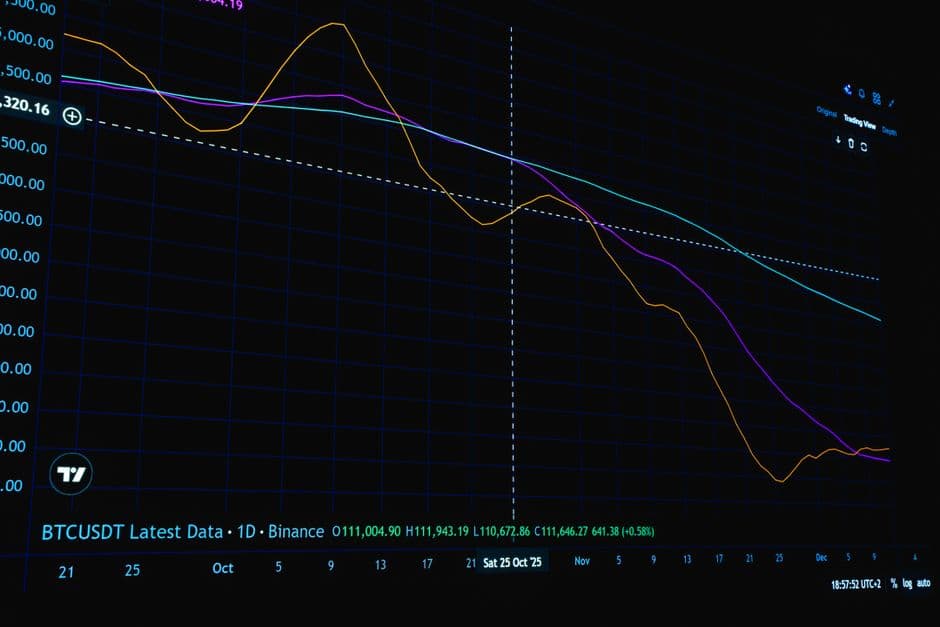
Bitcoin and Stocks: Does Correlation Kill Diversification?

The most repeated argument in favor of Bitcoin as a portfolio building block is its supposed lack of correlation with traditional assets: an asset that rises when others fall, or at least moves independently, improves diversification without sacrificing expected return. Recent data forces a serious nuancing of this claim.
Historically low correlation... until 2020

Between 2015 and 2019, the correlation between Bitcoin and the S&P 500 was indeed close to zero, even slightly negative over some rolling windows. This period fueled the narrative of Bitcoin as 'digital gold,' a safe-haven asset decoupled from traditional economic cycles.
Starting in 2020, with the massive influx of institutional investors and Bitcoin's growing integration into conventional multi-asset portfolios, the rolling 90-day correlation with equity indices rose sharply, regularly exceeding 0.5 during bull-market phases synchronized between crypto and tech stocks.
Why correlation spikes during periods of stress

The most problematic phenomenon for an investor seeking diversification isn't average correlation, but its tendency to converge toward 1 precisely during market shocks — a behavior documented across nearly all risky asset classes during episodes of generalized panic selling ('risk-off').
In March 2020 and during several equity corrections in 2022, Bitcoin fell simultaneously with equity indices, sometimes with greater amplitude due to its higher implicit leverage and more fragile liquidity during periods of stress. An asset meant to diversify a portfolio that collapses precisely when diversification is most needed loses much of its defensive usefulness.
What this changes for portfolio allocation
A correlation that rises during crises means the theoretical diversification benefit calculated over a long history (including calm periods) systematically overstates the actual protection offered during a shock — precisely when that protection is being sought. Allocation models that use a constant average correlation, like a standard Monte Carlo simulation, share this same limitation already documented for bonds during the 2022 rate shock.

This doesn't mean Bitcoin has no place in a diversified portfolio, but that its role should be understood as that of a high-beta, high-volatility asset rather than a true decoupled hedge — an important nuance for sizing exposure accordingly.
Does Bitcoin remain a diversification asset?
Over long horizons and outside acute crisis periods, correlation remains imperfect, and Bitcoin retains partial diversification value, notably due to its own price dynamics tied to adoption, regulation, and cycles specific to the crypto market. But the promise of total decoupling, particularly at the moment it would matter most, does not hold up under post-2020 data.
The role of spot Bitcoin ETFs in accelerating correlation
The approval of spot Bitcoin ETFs in the United States in 2024 considerably eased traditional institutional investors' access to Bitcoin, without requiring them to directly manage asset custody or dedicated crypto infrastructure. This increased accessibility mechanically strengthened Bitcoin's integration into multi-asset portfolios managed under the same rebalancing and risk management logic as conventional stocks and bonds.
This cross-integration has a direct effect on correlation: when the same institutional managers simultaneously adjust their equity and Bitcoin exposure in response to the same macroeconomic signals (inflation, policy rates, overall risk appetite), the two asset classes mechanically tend to move in a more synchronized way than in the era when Bitcoin remained confined to a specialized investor base disconnected from traditional institutional flows.
Distinguishing price correlation from risk correlation
A point often overlooked in Bitcoin-equity correlation analysis is the distinction between return correlation and tail-risk correlation. Two assets can display a moderate average correlation over a full cycle while sharing near-identical exposure to extreme tail scenarios — that is, to the worst 1% or 5% of market days, which are precisely the ones that determine a portfolio's actual behavior during a crisis.
A conditional correlation analysis, which specifically measures the two assets' behavior during days of sharp equity index declines rather than across the full history, gives a more accurate picture of the diversification benefit actually available during a shock — and this conditional correlation proves systematically higher than the unconditional average correlation for nearly all risky asset pairs, Bitcoin included.
To visualize the rolling correlation between Bitcoin and different asset classes over your own investment horizon, and simulate the real impact of adding it on a diversified portfolio's volatility, the analysis tools available at /outils let you explore these dynamics concretely and pedagogically, never as personalized investment advice.