SEC Accounting Probe into NVIDIA & Jensen Huang Exit: Governance Risk and Global Markets Stress Test
Factual YMYL-safe analysis of the SEC accounting probe into NVIDIA reported by Reuters on Nov 20, 2026 and key-person risk: KaTeX idiosyncratic vs. systematic risk math and a -14% shock stress test across S&P 500, Nasdaq, and MSCI World.
Last methodological review:

Quantitative Research · Quant Lab
Multi-Strategy Portfolio Risk Analyzer
Photo: Dietmar Rabich — Wikimedia Commons (CC BY-SA 4.0)
IN THIS ARTICLE
Key Takeaways (TL;DR)
- On November 20, 2026, Reuters reported an SEC accounting probe into NVIDIA alongside Jensen Huang's departure; critically, a regulatory inquiry does not constitute proof of wrongdoing or an enforcement finding.
- NVDA shares dropped roughly 13% to 14% over the week, pulling the Nasdaq Composite down ~5% YTD and triggering broad semiconductor sell-offs across Asia, Europe, and North America.
- Under market-cap weighting, single-issuer governance risk ceases to be diversifiable noise once one stock represents 4.8% to 8.5% of global and U.S. benchmarks.
- A quantitative stress test shows a -14% NVDA drawdown mechanically cuts -1.19% from the Nasdaq-100, -0.95% from the S&P 500, and -0.67% from the MSCI World before supply-chain spillover.
The trading session of November 20, 2026 delivered a stark reminder to global asset allocators that corporate governance remains a first-order market risk. According to reporting by Reuters—widely echoed across international financial outlets including the BBC and The Guardian—the U.S. Securities and Exchange Commission (SEC) has opened an inquiry examining accounting practices at NVIDIA Corporation (Nasdaq: NVDA), coinciding with market digestion of the departure of co-founder and longtime chief executive Jensen Huang.
Before analyzing portfolio mechanics, strict factual and regulatory discipline is essential: an SEC investigation or accounting probe is neither a formal accusation nor proof of wrongdoing. As explicitly stated in the SEC Division of Enforcement's own Enforcement Manual, inquiries are fact-finding processes that frequently conclude without enforcement action. Financial markets from New York and Toronto to London, Frankfurt, Tokyo, and Seoul, however, do not wait for multi-year legal resolutions—they immediately price in a governance uncertainty premium and key-person transition risk.
Over the week ending November 20, NVDA tumbled approximately 13% to 14%, helping push the Nasdaq Composite to roughly -5% year-to-date (YTD) and sparking sharp drawdowns across global semiconductor supply chains in Taiwan, South Korea, Japan, and the Netherlands. This analysis unpacks the dual governance and regulatory shock, formalizes the mathematical boundary between idiosyncratic and systematic risk, and stress-tests a -14% NVDA shock across major global equity benchmarks.
To measure how vulnerable your own multi-asset allocation is to single-issuer concentration and tail-correlation spikes, run a quantitative diagnostic in our Portfolio Risk Analyzer.
1. Anatomy of a Dual Shock: Accounting Uncertainty and Key-Person Risk
In institutional equity markets, two risk catalysts trigger immediate valuation-multiple compression (P/E and EV/EBITDA) regardless of near-term order backlogs:
- Revenue-recognition and related-party scrutiny: Whenever regulators examine multi-year supply commitments, circular financing structures with cloud customers, or revenue-recognition timing on complex server-rack shipments, global institutional allocators—U.S. pension funds, European UCITS managers, and Asian sovereign funds—demand a higher Equity Risk Premium (ERP). Uncertainty over historical or forward earnings quality impairs confidence in consensus EPS estimates, compressing multiples long before any formal accounting restatement is even contemplated.
- Key-person governance risk: For more than three decades, Jensen Huang served as the architectural and commercial anchor of NVIDIA, notably championing the CUDA software ecosystem that established its dominant moat. A leadership transition arriving just as hyperscalers accelerate custom silicon alternatives (Google TPUs, AWS Trainium) forces markets to re-evaluate how much of NVIDIA's valuation premium was tied to founder-led execution.
The simultaneous arrival of an unresolved regulatory inquiry and a landmark executive transition drove implied volatility sharply higher and transmitted stress within hours to European lithography leaders (ASML in Amsterdam) and Asian foundry and memory giants (TSMC in Taipei, SK Hynix in Seoul, Advantest in Tokyo).

2. Quantitative Framework: Systematic vs. Idiosyncratic Portfolio Risk
In the single-factor market model derived from the Capital Asset Pricing Model (CAPM), the excess return of asset decomposes into a systematic component driven by the global market return and an issuer-specific (idiosyncratic) shock with zero mean and zero market covariance:
Across an international portfolio holding securities with weights (), total portfolio variance separates cleanly into two terms:
where is portfolio market beta and is the specific variance of issuer .
Classical modern portfolio theory assumes that in a broad global index of 1,500 to 3,000 stocks, equal-weighted idiosyncratic risk vanishes as grows (), rendering single-company governance risk costlessly diversifiable.
Extreme market-cap concentration breaks that textbook assumption. When reaches 4.8% to 8.5% while surges during a governance shock, idiosyncratic variance re-emerges as a major driver of index-level drawdowns. Furthermore, using the portfolio covariance matrix , the Marginal Contribution to Risk (MCR) and total Risk Contribution (RC) of asset are defined as:
Because NVIDIA's realized annualized volatility ( to in stress regimes) runs three to four times higher than a diversified global equity benchmark ( to ), its share of total portfolio risk () routinely reaches 12% to 20% in U.S. and tech-heavy benchmarks—far exceeding its nominal capital weight.
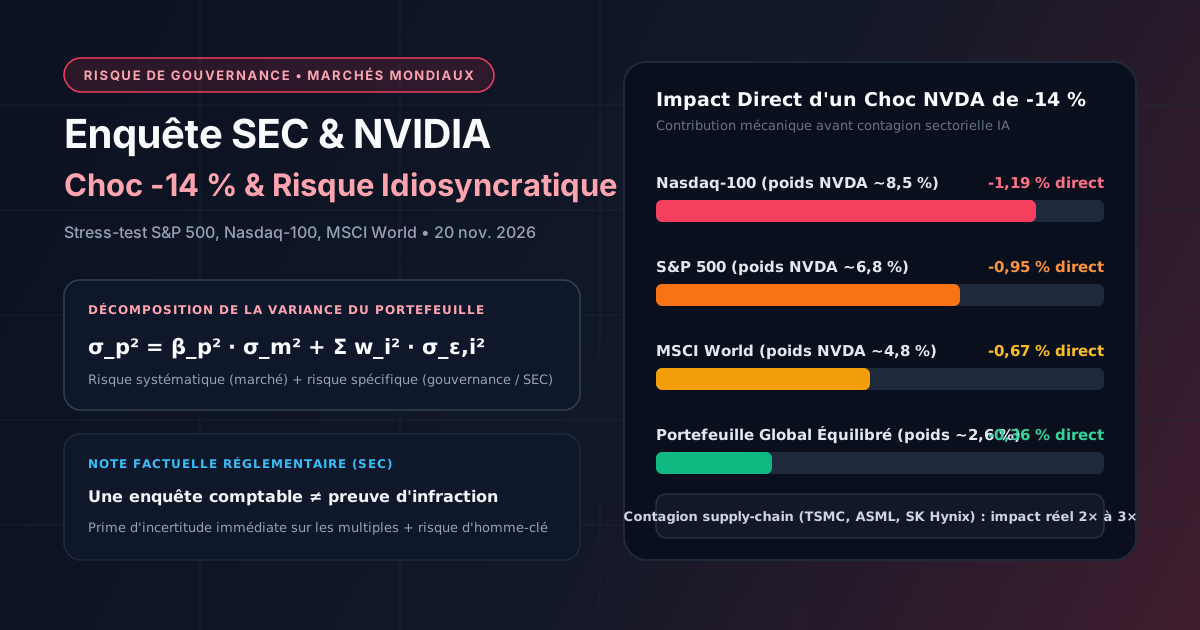
3. Global Stress Test: Transmitting a -14% NVDA Shock Across Benchmarks
To quantify the real-world impact for investors in the United States, Europe, Asia, and Canada, we evaluate a weekly shock of at two levels:
- Direct arithmetic drag: , holding all other constituents constant.
- Spillover-adjusted impact: , capturing conditional co-movement across foundries, high-bandwidth memory (HBM), lithography, and cloud hyperscalers.
| Global Benchmark / ETF Proxy | Primary Investor Base | Indicative NVDA Weight () | Direct Shock (-14% NVDA) | Estimated Total Shock (with AI Spillover) | Governance Concentration Vulnerability |
|---|---|---|---|---|---|
| Nasdaq-100 (QQQ / EQQQ / ZNQ) | US / Global Tech | ~8.5% | -1.19% | -3.2% to -4.1% | Critical (dual sector + issuer risk) |
| S&P 500 (SPY / VOO / CSPX / VFV) | United States / Global | ~6.8% | -0.95% | -2.1% to -2.8% | High (Top-7 mega-cap dominance) |
| MSCI World (IWDA / URTH / XWD) | Europe / Global | ~4.8% | -0.67% | -1.5% to -2.1% | Moderate-High (~70% U.S. weight) |
| FTSE All-World / VWCE / XEQT | Global / Canada | ~2.6% to 3.9% | -0.36% to -0.55% | -1.1% to -1.6% | Moderate (regional diversification buffer) |
| MSCI World Equal Weight | Global Equal-Weight | ~0.07% | -0.01% | -0.3% to -0.6% | Low (true idiosyncratic diversification) |
Two operational takeaways stand out for international allocators:
- A European investor holding a standard UCITS MSCI World ETF (
IWDA/SWDA) or a North American investor holding an S&P 500 tracker absorbs a meaningful single-stock governance hit even without owning a single direct share of NVIDIA. - Asian equity markets heavily weighted toward AI hardware manufacturing (Taiwan via TSMC, South Korea via SK Hynix and Samsung Electronics) experience disproportionate second-order drawdowns because their capital-expenditure visibility hinges on uninterrupted next-generation GPU demand.
4. Quantitative Governance Risk Discipline for Global Investors
Navigating an evolving headline event like November 20, 2026 requires replacing reactive decision-making with three verifiable portfolio-management principles:
- Audit risk contribution rather than headline weight: Knowing a single stock represents "5%" of an index obscures its true contribution to Value at Risk (VaR) and tail drawdowns when cross-asset correlations tighten toward . Stress-test your combined holdings inside our Portfolio Risk Analyzer.
- Separate regulatory uncertainty from adjudicated outcomes: Historically, SEC inquiries span a wide outcome distribution—from quiet closure with no enforcement action or minor administrative fines to formal accounting restatements. Making all-or-nothing portfolio shifts during peak headline volatility exposes investors to severe whipsaw risk.
- Restore true diversification across factors and weighting schemes: Pairing core cap-weighted equity holdings with genuinely low-correlation sleeves—investment-grade sovereign bonds, international value equities, or equal-weighted indices—directly shrinks the term in portfolio variance.
The events of November 20, 2026 underscore an enduring lesson of institutional risk management: technological leadership never eliminates corporate governance risk, and only mathematical portfolio architecture insulates capital from unexpected issuer shocks.

Primary Sources and Institutional References
- Reuters (November 20, 2026) — Market coverage of the reported SEC accounting probe into NVIDIA, Jensen Huang's leadership exit, and the ~13%–14% weekly equity sell-off.
- U.S. Securities and Exchange Commission (SEC) — Division of Enforcement — Enforcement Manual (procedural framework clarifying that an SEC inquiry does not imply a finding of securities-law violation) and NVIDIA Corporation Form 10-K (EDGAR).
- BBC News & The Guardian (November 2026) — International financial reporting on the global technology sell-off across U.S., European, and Asian equity markets.
- MSCI Inc. & S&P Dow Jones Indices — MSCI World Index Factsheet and S&P 500 Index Methodology (float-adjusted market-cap weighting rules and top-constituent concentration data).
Analytical Disclaimer: This article is published strictly for educational and quantitative informational purposes. A reported regulatory inquiry is not proof of wrongdoing or illegal conduct. Nothing herein constitutes personalized financial advice or a recommendation to buy, sell, or hold any security.
Multi-Strategy Portfolio Risk Analyzer
Compute Pearson correlation matrices, diversification benefit, joint drawdown, and portfolio Sharpe.
Analyze Portfolio RiskIndependent financial engineer based in Quebec, Canada, Alain Legrand builds and audits TrueVerdikt's deterministic models: Series A/F mutual fund vs. TSX ETF fee comparisons, RRSP/FHSA tax arbitrage, Canadian mortgage actuarial schedules, and statistical overfitting detection (Deflated Sharpe Ratio & CPCV).
Primary Regulatory & Academic Sources
- OSFI — Guideline B-20 (Residential Mortgage Underwriting) — Residential mortgage underwriting practices, procedures, and minimum qualifying rate stress-test.
- CRA — FHSA, RRSP & Home Buyers' Plan — Official contribution limits ($8,000/yr, $40,000 lifetime FHSA cap), tax deductions, and HBP repayment rules.
- CIFSC — Canadian Investment Funds Standards Committee — Standardized classification of Canadian mutual funds and ETFs used across our MER fee comparator.
- Bailey & López de Prado (2014) — The Deflated Sharpe Ratio — Correcting for Selection Bias, Backtest Overfitting, and Non-Normality. The Journal of Portfolio Management, 40(5), 94–107 (SSRN).